The DOTS calculator formula
DOTS = total × 500 ÷ (A·x⁴ + B·x³ + C·x² + D·x + E), where x is bodyweight in kilograms and the total is in kilograms.
| Coefficient | Men | Women |
|---|---|---|
| A | −0.0000010930 | −0.0000010706 |
| B | 0.0007391293 | 0.0005158568 |
| C | −0.1918759221 | −0.1126655495 |
| D | 24.0900756 | 13.6175032 |
| E | −307.75076 | −57.96288 |
| Bodyweight range | 40–210 kg | 40–150 kg |
The DOTS calculator treats bodyweights outside the range as the nearest end of it. These are the coefficients used by OpenPowerlifting, the open database of meet results. DOTS stands for "Dynamic Objective Team Scoring"; the formula's author is Tim Konertz, for the German federation BVDK.
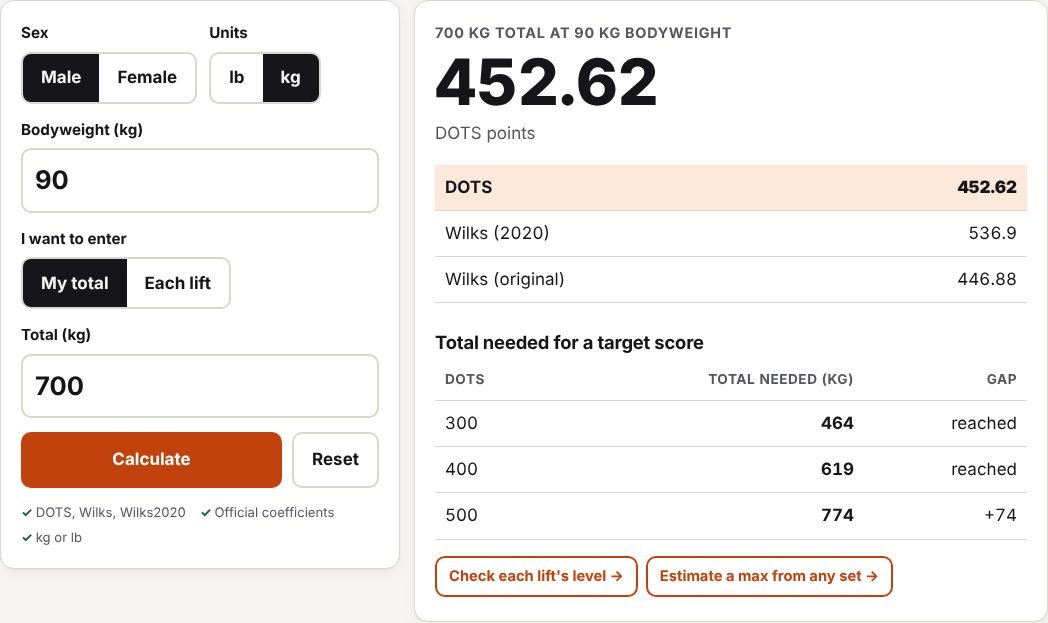
DOTS calculator example
A 90 kg man with a 700 kg total scores 452.62 DOTS. For the same lift, the DOTS calculator shows 536.90 Wilks2020 points and 446.88 original Wilks points. It also shows he would need a 774 kg total to reach 500 DOTS.
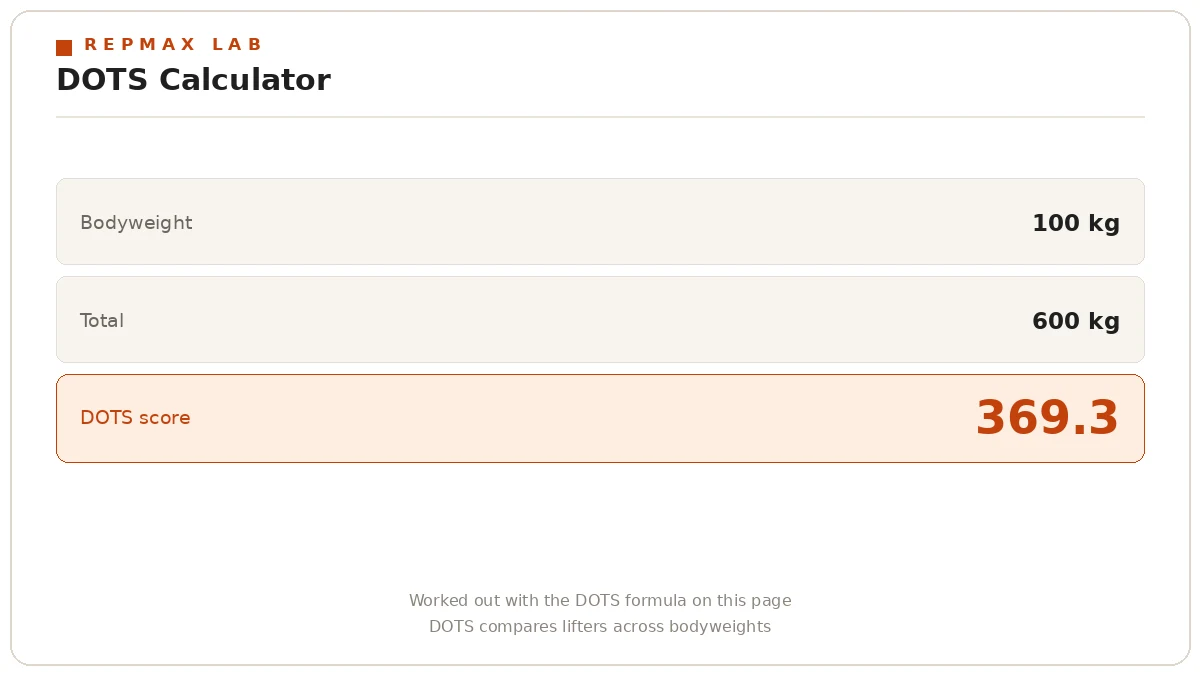
Total needed for 400 DOTS
A useful yardstick when setting a meet goal. The DOTS calculator shows the same targets for your own bodyweight. Totals in kilograms, rounded up.
| Bodyweight | Men | Women |
|---|---|---|
| 60 kg | 474 kg | 361 kg |
| 70 kg | 533 kg | 396 kg |
| 80 kg | 581 kg | 425 kg |
| 90 kg | 619 kg | 449 kg |
| 100 kg | 650 kg | 469 kg |
| 110 kg | 676 kg | 486 kg |
Wilks and Wilks2020
The Wilks formula, by Robert Wilks, was the standard best-lifter formula for decades and was used by the IPF until the end of 2018. It uses a fifth-order polynomial: Wilks = total × 500 ÷ (a + b·x + c·x² + d·x³ + e·x⁴ + f·x⁵). In March 2020 the coefficients were rebalanced and the numerator changed to 600, so Wilks2020 scores run higher than original Wilks for the same lift. The DOTS calculator above also works as a Wilks calculator, so you can compare with older results.
Frequently asked questions
What is a good DOTS score?
There is no official scale, so no DOTS score calculator can label a score as good on its own. As a reference point, the table on this page shows the total needed for 400 DOTS at common bodyweights. Compare your score with lifters in your federation, division and weight class, because those are the people the score was designed to rank you against.
What is the difference between DOTS and Wilks?
Both turn a powerlifting total into a score that adjusts for bodyweight. DOTS was created by the German federation BVDK after the IPF moved away from Wilks. For mid-weight lifters it gives numbers close to original Wilks; the two differ more at very light and very heavy bodyweights. Wilks2020 is a 2020 update to Wilks with a different scale, so its numbers run higher.
Can I compare men and women with DOTS?
Yes, that is one of the reasons DOTS was created: the BVDK runs team competitions with men and women on the same team. The formula uses a separate curve for each sex so that the scores sit on one scale.
Does the IPF use DOTS?
The IPF uses its own IPF GL points, not DOTS or Wilks. Many other federations and meets use DOTS for best-lifter awards. Check your meet rules.
Sources
- OpenPowerlifting project, opl-data, coefficient definitions for DOTS, Wilks and Wilks2020 (crates/coefficients).
- Wikipedia, Wilks coefficient (original and 2020 coefficients).
Related calculators and guides