How to read your level
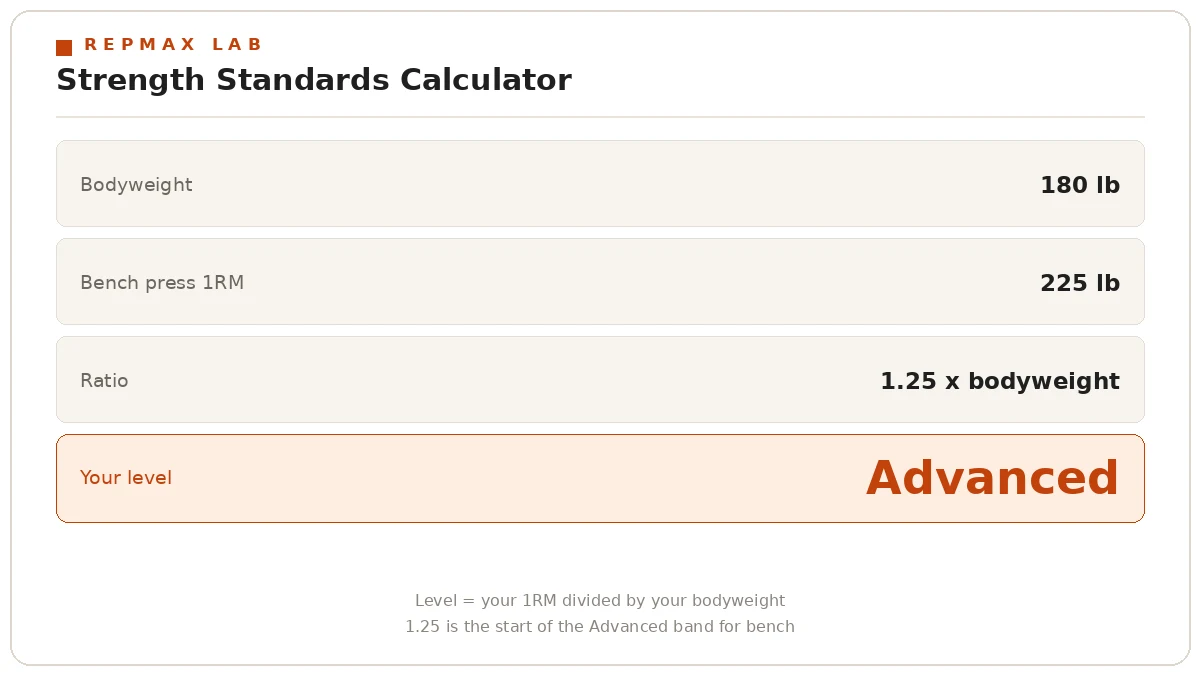
Your level comes from one number: your one-rep max divided by your bodyweight. A 180 lb man who benches 225 lb has a ratio of 1.25, which is the start of the Advanced band for the bench press.
- Beginner: typical in the first few months of lifting.
- Novice: about 6–12 months of consistent training.
- Intermediate: several years of steady, structured training. Most regular gym-goers who train hard end up here.
- Advanced: years of focused work. You will be one of the strongest people in most gyms.
- Elite: the level of competitive lifters.
The time frames are rough. People who start young, sleep well and follow a progressive program move faster. Older lifters and people who train less often move slower, and that is fine.
Strength standards by bodyweight
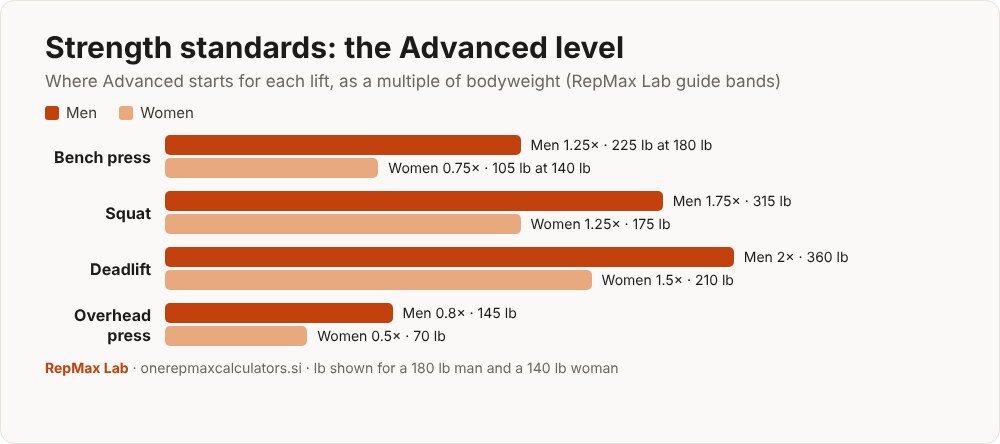
Multiply your bodyweight by the number in the table to get the lift needed for each level. Each figure is where that level starts.
Strength standards for men
For men, Intermediate starts at 0.75 × bodyweight on the bench press, 1.25 × on the squat and 1.5 × on the deadlift. Advanced starts at 1.25 ×, 1.75 × and 2 ×. In practice, a bodyweight bench, a 1.5 × squat and a double-bodyweight deadlift mark a well-trained man.
| Lift | Novice | Intermediate | Advanced | Elite |
|---|---|---|---|---|
| Bench press | 0.5× | 0.75× | 1.25× | 1.75× |
| Squat | 0.75× | 1.25× | 1.75× | 2.5× |
| Deadlift | 1.0× | 1.5× | 2.0× | 2.75× |
| Overhead press | 0.35× | 0.55× | 0.8× | 1.05× |
Strength standards for women
For women, Intermediate starts at 0.5 × bodyweight on the bench press, 0.75 × on the squat and 1 × on the deadlift. Advanced starts at 0.75 ×, 1.25 × and 1.5 ×. The gap with men is widest on the bench and overhead press, where upper-body muscle mass matters most.
| Lift | Novice | Intermediate | Advanced | Elite |
|---|---|---|---|---|
| Bench press | 0.25× | 0.5× | 0.75× | 1.1× |
| Squat | 0.5× | 0.75× | 1.25× | 1.9× |
| Deadlift | 0.5× | 1.0× | 1.5× | 2.25× |
| Overhead press | 0.2× | 0.35× | 0.5× | 0.7× |
Below the Novice figure is Beginner. Example: a 70 kg woman needs 0.75 × 70 = 52.5 kg on the bench press to reach Advanced.
Want to compare yourself with people your age instead of a training scale? See the average bench press by age for men and women, from the Cooper Institute norms.
Where these numbers come from
The level bands are our own guide scale. They use round bodyweight ratios that line up with long-standing coaching rules of thumb, such as a bodyweight bench press and a double-bodyweight deadlift for a well-trained man. They are not survey percentiles, so treat them as a practical yardstick rather than a ranking.
To anchor the top of the scale, we compare it with real competition data. A 2024 study in the Journal of Science and Medicine in Sport analysed 809,986 entries from drug-tested, unequipped powerlifting meets (van den Hoek et al., 2024). Among lifters aged 18–35, the top 10% reached:
| Lift | Men | Women |
|---|---|---|
| Squat | 2.83× | 2.26× |
| Bench press | 1.95× | 1.35× |
| Deadlift | 3.25× | 2.66× |
Our Elite threshold sits a little below those figures, so reaching it puts you close to strong competitive lifters. The same study found relative strength peaks between 18 and 35 and falls with age, and that lighter weight classes lift more per kilogram of bodyweight.
What can skew the comparison
- Squat depth. The standards assume a squat to at least parallel. Half squats inflate the number.
- Equipment. Knee wraps, bench shirts and squat suits add weight. Belts and sleeves make only a small difference.
- Bench pause and touch. Touch-and-go benching from a big arch is easier than a paused competition bench.
- Estimated maxes. A 1RM estimated from a set of 10+ reps can be off by several percent. Use a heavier set if you can. See how accurate 1RM calculators are.
Frequently asked questions
Is a bodyweight bench press good?
For a man, a bench press equal to your bodyweight (1.0×) sits in the Intermediate band on this scale, and 1.25× is Advanced. For a woman, a bodyweight bench is well into the Advanced band. Most people need a few years of steady training to get there.
Should I use my real 1RM or an estimate?
Either works. If you have not tested a max recently, switch to From a set and enter a hard set of 3–8 reps. The calculator estimates your 1RM with the same seven formulas as the one rep max calculator and rates that.
Why are the women’s standards lower?
On average, women carry less muscle mass relative to bodyweight, especially in the upper body, so the same ratio represents a stronger lift. The gap is largest on the bench and overhead press. Competition data shows the same pattern.
Do these standards account for age?
No. They assume an adult in roughly the 18–40 range. Relative strength declines with age in competition data, so if you are older, reaching a given band is a bigger achievement than the label suggests.
Why do heavier lifters score lower?
Strength does not rise in a straight line with bodyweight. Lighter lifters usually lift more per kilogram of bodyweight, and heavier lifters lift more in absolute terms. A simple bodyweight ratio is easy to use but slightly favours lighter people.
Is my data saved?
Everything runs in your browser. Your unit, sex and last bodyweight are remembered on this device so you do not have to type them again. Nothing is sent to us.
What are strength standards?
Strength standards are benchmarks that show how your lifts compare with other lifters of the same sex and bodyweight. These strength standards run from Beginner to Elite.
Are these strength standards for a one-rep max?
Yes. The strength standards use your one-rep max, real or estimated, as a multiple of your bodyweight.
Related calculators and guides