Dumbbell to barbell bench calculator chart
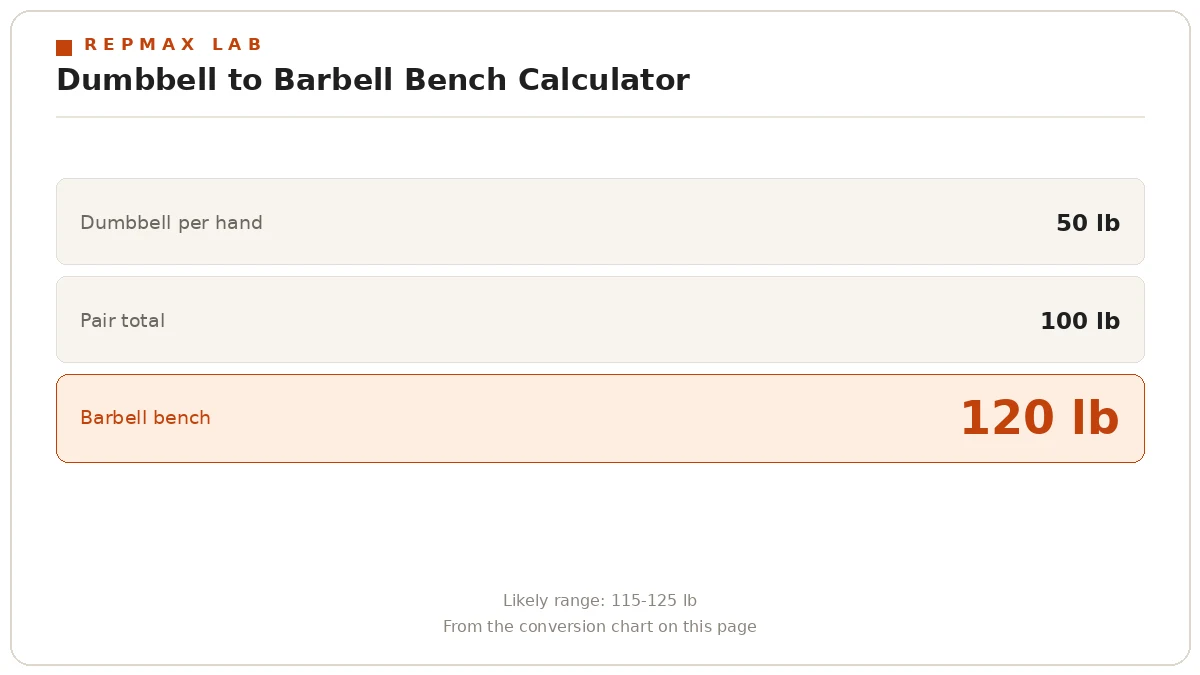
Dumbbell one-rep max per hand, and the barbell bench it usually goes with. Weights in lb, rounded to 5 lb.
| Dumbbells (each hand) | Pair total | Barbell bench estimate | Likely range |
|---|---|---|---|
| 30 lb | 60 lb | 70 lb | 70–75 lb |
| 40 lb | 80 lb | 95 lb | 90–100 lb |
| 50 lb | 100 lb | 120 lb | 115–125 lb |
| 60 lb | 120 lb | 145 lb | 135–150 lb |
| 70 lb | 140 lb | 170 lb | 160–175 lb |
| 80 lb | 160 lb | 195 lb | 185–200 lb |
| 90 lb | 180 lb | 215 lb | 205–230 lb |
| 100 lb | 200 lb | 240 lb | 230–255 lb |
| 110 lb | 220 lb | 265 lb | 250–280 lb |
| 120 lb | 240 lb | 290 lb | 275–305 lb |
In a dumbbell vs barbell bench comparison going the other way, a pair of dumbbells is about 83% of your barbell bench, so each dumbbell is about 41.5% of it. A 225 lb bench works out to about 93 lb per hand, so 90–95 lb dumbbells for a single.
Where the 17% comes from
A 2011 study in the Journal of Sports Sciences tested 12 resistance-trained men on three chest presses: barbell, Smith machine and dumbbells (Saeterbakken, van den Tillaar and Fimland, 2011). The dumbbell 1RM was 17% lower than the barbell 1RM and 14% lower than the Smith machine, and the barbell was about 3% higher than the Smith machine.
The dumbbell to barbell bench calculator turns that into a simple rule: barbell ≈ pair of dumbbells ÷ 0.83. It is one small study of young, trained men, so the result comes with a ±5% range. We did not find a larger study that measured the same thing.
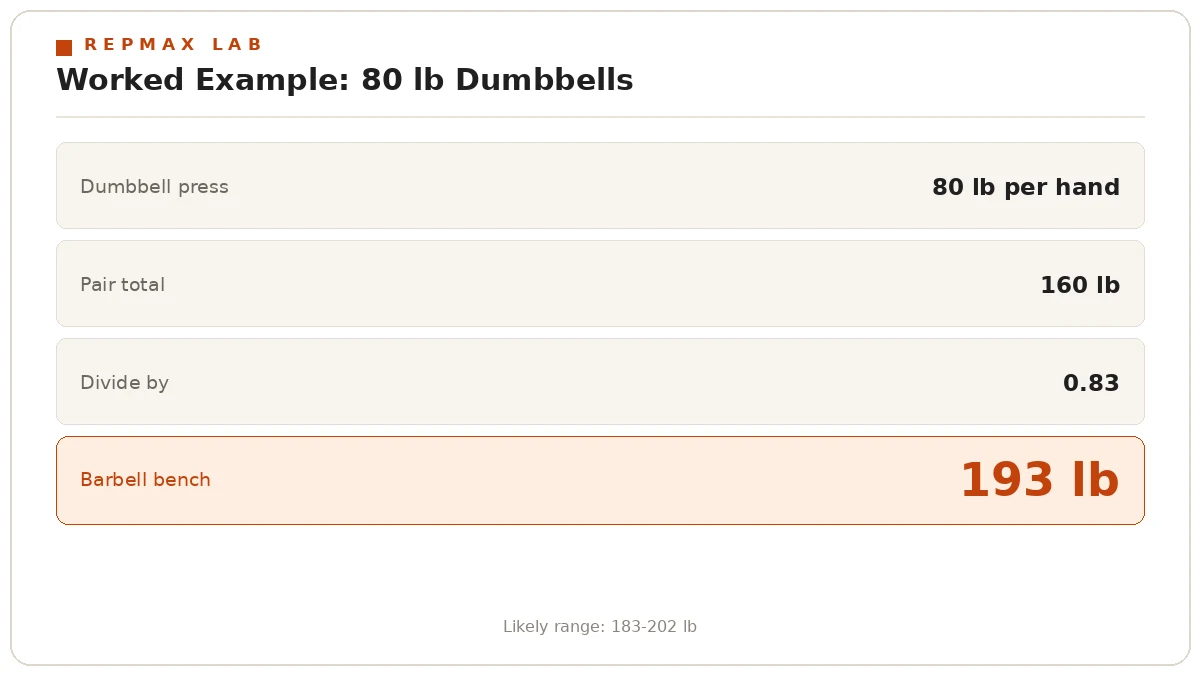
Dumbbell to barbell bench calculator example
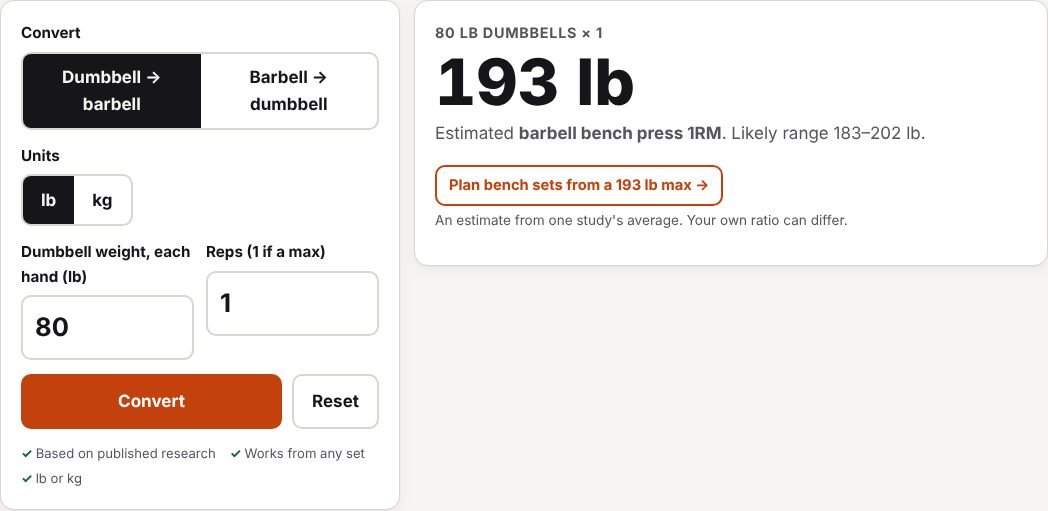
Pressing a pair of 80 lb dumbbells once is 160 lb in total. The dumbbell to barbell bench calculator divides that by 0.83, which gives a barbell bench of about 193 lb, with a likely range of 183–202 lb.
How to get a better estimate
- Use a hard set. Enter a set you took close to failure. The dumbbell to barbell bench calculator estimates your dumbbell max with the same seven formulas as our bench press max calculator, then converts it.
- Count only good reps. Reps where the dumbbells stall halfway or drift wide don't count.
- Check it against a real set. If you get the chance, do a barbell set at the suggested weight for 5 reps at RPE 8 using the RPE chart, and adjust from there.
Frequently asked questions
How much can I bench if I can press 80 lb dumbbells?
If 80 lb dumbbells are your one-rep max, your barbell bench is likely around 195 lb (185–200 lb). If you pressed them for several reps, enter the reps in the dumbbell to barbell bench calculator and it estimates your dumbbell max first.
Dumbbell vs barbell bench: why is the dumbbell bench weaker?
Each arm has to balance its own weight, the dumbbells can drift apart, and getting heavy dumbbells into position is hard in itself. In the study we use, muscle activity in the chest was similar on both lifts, so the gap is about stability and control rather than the chest working less.
Is the 17% gap the same for everyone?
No. It is an average from 12 trained men, and individuals differ. Your own gap will depend on things like how often you train each lift. That is why the calculator shows a range of ±5% rather than one exact number.
Does the dumbbell to bench press calculator work for incline or seated presses?
No. The ratio is for the flat dumbbell bench against the flat barbell bench. Incline and overhead presses have different ratios that we have not found good data for.
Sources
- Saeterbakken, A. H., van den Tillaar, R., & Fimland, M. S. (2011). A comparison of muscle activity and 1-RM strength of three chest-press exercises with different stability requirements. Journal of Sports Sciences, 29(5), 533–538. doi:10.1080/02640414.2010.543916
Related calculators and guides