Powerlifting weight classes are bodyweight categories that group lifters of similar size so strength competes fairly. The International Powerlifting Federation (IPF) runs 8 men’s classes from 59 kg (130.1 lb) to 120+ kg and 8 women’s classes from 47 kg (103.6 lb) to 84+ kg, with extra youth classes on top. US charts differ. Domestic federations and high school leagues each publish their own.
Key Takeaways
- The IPF and its US affiliate, Powerlifting America, use 8 open men’s classes (59 kg to 120+ kg) and 8 open women’s classes (47 kg to 84+ kg).
- Sub-junior and junior lifters in IPF-rules meets get one extra class each: 53 kg (116.8 lb) for males and 43 kg (94.8 lb) for females.
- The United States Powerlifting Association (USPA) uses traditional classes such as 82.5 kg (181.9 lb) and 100 kg (220.5 lb).
- Texas high school powerlifting sets classes in pounds, starting at 114 lb (51.7 kg) for boys and 97 lb (44.0 kg) for girls.
- IPF-rules meets weigh lifters starting 2 hours before competition, so a class choice must match a lifter’s real bodyweight.
- DOTS and IPF GL Points let lifters and fans compare totals across different weight classes.
What Is Powerlifting?
Powerlifting is a strength sport in which lifters get three attempts each at the squat, bench press and deadlift, and the best successful lift of each adds up to a competition total. The winning rule is simple. Whoever posts the highest total in a weight class and division at a sanctioned meet wins that class outright.
You’ll sometimes see the name split into two words, power lifting, though every major federation writes it as one. Don’t confuse it with Olympic weightlifting. That sport tests the snatch and the clean and jerk instead.
Equipment splits the field too. Classic or raw lifters compete with a belt and knee sleeves, and wrist wraps are allowed as well. Equipped lifters go further, pulling on supportive suits and bench shirts that help them move more weight on the bar.
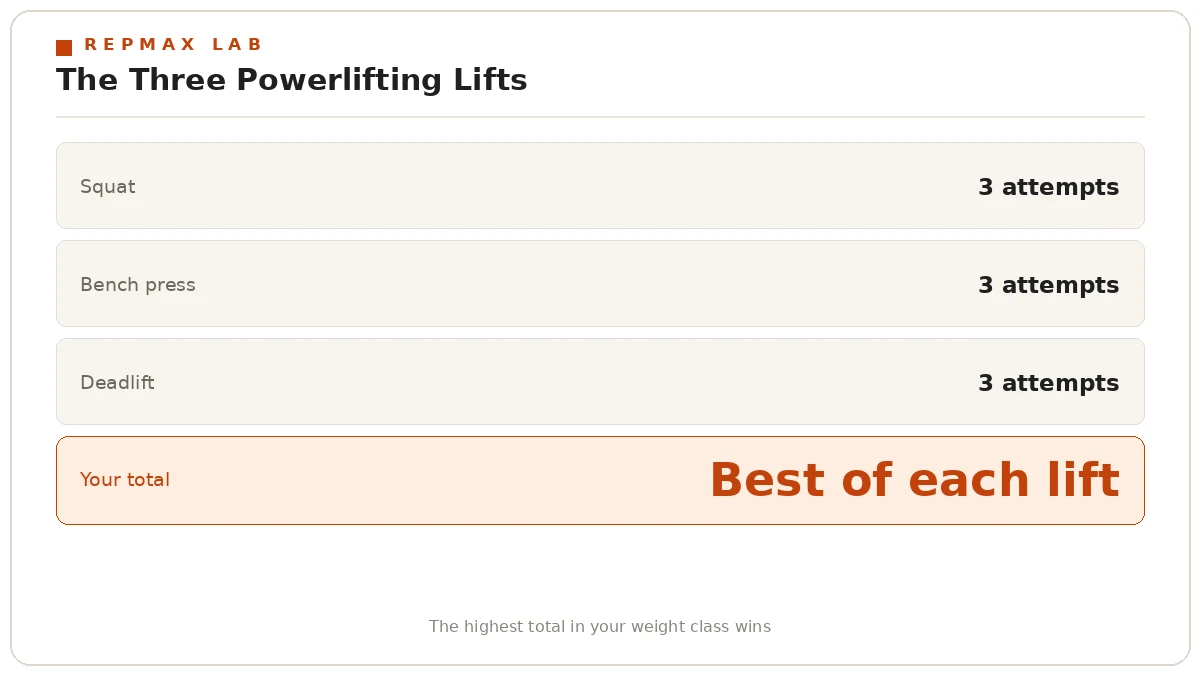
Here are the three lifts in meet order, with the core rule judges enforce under IPF rules.
| Lift | Meet Order | Core Judging Rule |
|---|---|---|
| Squat | First | Hip crease drops below top of the knee. |
| Bench Press | Second | Bar pauses on chest until press command. |
| Deadlift | Third | Lifter stands erect with knees locked. |
Each lift gets three tries. That makes nine attempts across a full meet. Fail all three on any single lift, though, and the lifter records no total and has no chance to place in the class.
Are There Weight Classes in Powerlifting?
Yes, every sanctioned powerlifting meet splits lifters into weight classes by bodyweight at weigh-in, and also by sex, age division and equipment category. Bodyweight drives strength. A 59 kg (130.1 lb) lifter never chases the same class placing as a 120 kg (264.6 lb) lifter, because body mass strongly affects how much weight a person can move.
Classes keep things fair. Inside each one, the total decides placings, while points formulas such as DOTS take over when a meet hands out best lifter awards across classes.
How a Class Limit Works
Each class number is an upper bodyweight limit. Weigh in at exactly 74.00 kg (163.1 lb) and you fit the IPF 74 kg class, but a lifter at 74.05 kg moves up to the 83 kg class.
The floor comes from the class below. So the IPF 83 kg class covers anyone from 74.01 kg to 83.00 kg (163.2 lb to 183.0 lb), with no gap between neighboring classes.
If you track bodyweight in pounds at home, you’ll need to convert, since national and international federations weigh athletes in kilograms. One kilogram equals 2.2046 pounds.
The Super Heavyweight Class
Super heavyweight has no upper limit. In IPF meets, men land there at 120+ kg (over 264.6 lb), and women qualify at 84+ kg (over 185.2 lb) on the platform.
Past those numbers, extra bodyweight doesn’t matter. Traditional federations set the cutoff higher, though, so a heavy lifter’s class name changes from one federation to the next.
What Are the Weight Classes in Powerlifting?
The weight classes in powerlifting depend on the federation: IPF-affiliated federations use 59 kg to 120+ kg for men and 47 kg to 84+ kg for women, while traditional federations such as the USPA use older classes like 67.5 kg, 82.5 kg and 110 kg. High school leagues often use pound-based classes instead.
Ask what are the weight classes for powerlifting, and the honest reply begins with a different question about which federation runs the meet. US lifters run into three main systems.
Here’s how the three main class systems stack up for US lifters.
| System | Used By | Male Range | Female Range | Units |
|---|---|---|---|---|
| IPF Modern | IPF, Powerlifting America, USAPL | 59 kg to 120+ kg | 47 kg to 84+ kg | Kilograms |
| Traditional | USPA and several other federations | 52 kg upward, top varies | 44 kg upward, top varies | Kilograms |
| Texas High School | THSPA (boys), THSWPA (girls) | 114 lb to SHW | 97 lb to SHW | Pounds |
Youth lifters get a bonus. IPF-style meets add one lighter class for them, 53 kg (116.8 lb) for males and 43 kg (94.8 lb) for females.
IPF and Powerlifting America Weight Classes
The International Powerlifting Federation (IPF) and its US affiliate, Powerlifting America, use 8 open men’s classes from 59 kg to 120+ kg and 8 open women’s classes from 47 kg to 84+ kg, plus one extra youth class for each sex. Every Powerlifting America meet uses these limits.
Powerlifting America is a drug-tested federation, and it took over from USA Powerlifting (USAPL) as the US member of the IPF. Want a shot at IPF world championships? That path runs through Powerlifting America.
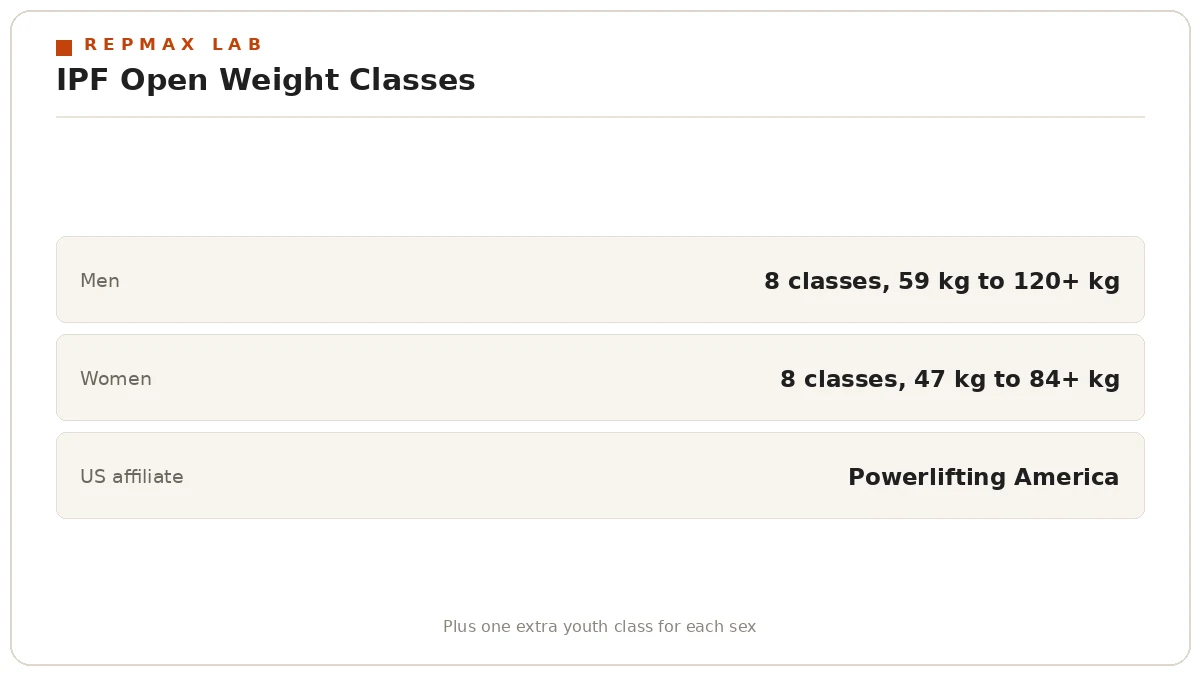
Men’s IPF Weight Classes
The IPF men’s classes appear below with pound limits and the divisions eligible for each.
| Class (kg) | Limit (lb) | Eligible Divisions |
|---|---|---|
| 53 | 116.8 | Sub-junior and junior only |
| 59 | 130.1 | All divisions |
| 66 | 145.5 | All divisions |
| 74 | 163.1 | All divisions |
| 83 | 183.0 | All divisions |
| 93 | 205.0 | All divisions |
| 105 | 231.5 | All divisions |
| 120 | 264.6 | All divisions |
| 120+ | No upper limit | All divisions |
A man who weighs 180 lb (81.6 kg) each morning fits the 83 kg class with no cut needed at all. Someone at 210 lb (95.3 kg) is different. He’s over the 93 kg limit, so he lands in the 105 kg class.
Women’s IPF Weight Classes
Powerlifting women in IPF-affiliated meets pick from the classes below, listed with pound limits and eligibility.
| Class (kg) | Limit (lb) | Eligible Divisions |
|---|---|---|
| 43 | 94.8 | Sub-junior and junior only |
| 47 | 103.6 | All divisions |
| 52 | 114.6 | All divisions |
| 57 | 125.7 | All divisions |
| 63 | 138.9 | All divisions |
| 69 | 152.1 | All divisions |
| 76 | 167.6 | All divisions |
| 84 | 185.2 | All divisions |
| 84+ | No upper limit | All divisions |
One older class is gone. The IPF replaced the old 72 kg women’s class with the 69 kg and 76 kg classes, so any weight classes powerlifting chart that still lists 72 kg predates that change.
A woman who weighs 150 lb (68.0 kg) fits the 69 kg class with about 2 lb (1 kg) to spare. Add 10 lb and things change. At 160 lb (72.6 kg), she competes in the 76 kg class.
USA Powerlifting Weight Classes
USA Powerlifting (USAPL) is a drug-tested US federation whose rulebook has followed the IPF kilogram class limits, so its USA powerlifting weight classes run from 59 kg to 120+ kg for men and 47 kg to 84+ kg for women. Lifters should confirm the current version on the USAPL website before registering.
The name causes confusion. Many US lifters say USA powerlifting weight classes when they mean the IPF chart, because USAPL served as the US IPF affiliate for many years before Powerlifting America took over that role.
USAPL still runs its own national championships and state meets, plus a slate of high school events, and it keeps a records list separate from the IPF’s. Those records are its own.
These two drug-tested federations are the pair US lifters mix up most often.
| Federation | IPF Member | Drug Tested | Class System |
|---|---|---|---|
| Powerlifting America | Yes | Yes | IPF kg classes |
| USA Powerlifting (USAPL) | No | Yes | IPF-style kg classes |
USPA and Traditional Weight Classes
The United States Powerlifting Association (USPA) uses traditional weight classes, an older kilogram ladder that includes classes such as 67.5 kg (148.8 lb) and 82.5 kg (181.9 lb), and it runs both drug-tested and untested divisions. The spacing differs. Compared with the IPF chart, these traditional classes sit closer together at the light end and extend into heavier classes.
Below is the traditional ladder in kilograms, with pound limits.
| Class (kg) | Limit (lb) |
|---|---|
| 44 | 97.0 |
| 48 | 105.8 |
| 52 | 114.6 |
| 56 | 123.5 |
| 60 | 132.3 |
| 67.5 | 148.8 |
| 75 | 165.3 |
| 82.5 | 181.9 |
| 90 | 198.4 |
| 100 | 220.5 |
| 110 | 242.5 |
| 125 | 275.6 |
Women start at 44 kg on the traditional ladder. Men begin at 52 kg. The USPA rulebook adds heavier classes at the top of both ladders, so pull the current edition of that rulebook for the exact super heavyweight cutoff.
Texas lifters will notice something. The traditional ladder lines up closely with the state’s high school pound classes, and the 82.5 kg class (181.9 lb) sits right beside the Texas 181 lb class.
High School Powerlifting Weight Classes
High school powerlifting weight classes in the USA are set in pounds by state associations, and Texas runs separate boys’ and girls’ leagues through the Texas High School Powerlifting Association (THSPA) and the Texas High School Women’s Powerlifting Association (THSWPA). Boys start at 114 lb and girls at 97 lb.
Students outside state leagues lift in high school divisions run by national federations, which use that federation’s kilogram classes. Rules reset yearly. Parents check the association or federation handbook each season, because eligibility applies season by season, and the same goes for class charts and weigh-in rules.
Texas Boys’ Classes (THSPA)
The THSPA boys’ classes appear below with kilogram equivalents.
| Class (lb) | Limit (kg) |
|---|---|
| 114 | 51.7 |
| 123 | 55.8 |
| 132 | 59.9 |
| 148 | 67.1 |
| 165 | 74.8 |
| 181 | 82.1 |
| 198 | 89.8 |
| 220 | 99.8 |
| 242 | 109.8 |
| 275 | 124.7 |
| SHW | Over 124.7 |
Texas Girls’ Classes (THSWPA)
THSWPA girls’ classes follow, with kilogram equivalents.
| Class (lb) | Limit (kg) |
|---|---|
| 97 | 44.0 |
| 105 | 47.6 |
| 114 | 51.7 |
| 123 | 55.8 |
| 132 | 59.9 |
| 148 | 67.1 |
| 165 | 74.8 |
| 181 | 82.1 |
| 198 | 89.8 |
| 220 | 99.8 |
| 259 | 117.5 |
| SHW | Over 117.5 |
Treat these charts as a starting point. Confirm both against the current THSPA and THSWPA handbooks before each season, because state associations can revise classes between school years.
Age Divisions in Powerlifting
Powerlifting age divisions group lifters into sub-junior (14 to 18), junior (19 to 23), open and masters (40 and older) categories under IPF rules, and every age division uses the same weight classes as the open division, apart from the extra youth classes. Age counts by the calendar year in which a lifter reaches that age.
IPF age divisions and the extra classes each one can use are listed below.
| Division | Age Range | Extra Classes |
|---|---|---|
| Sub-Junior | 14 to 18 | 53 kg men, 43 kg women |
| Junior | 19 to 23 | 53 kg men, 43 kg women |
| Open | Any eligible age | N/A |
| Masters 1 | 40 to 49 | N/A |
| Masters 2 | 50 to 59 | N/A |
| Masters 3 | 60 to 69 | N/A |
| Masters 4 | 70 and older | N/A |
Masters age group classes match the open chart. So a 52-year-old woman who weighs 70 kg (154.3 lb) lifts in the 76 kg class and competes in Masters 2.
Senior games work differently. Each state senior games event publishes its own age bands and class charts, so masters lifters entering one should read that event’s chart rather than a federation’s.
When Is the Weigh-In at a Powerlifting Meet?
At IPF and Powerlifting America meets, the weigh-in starts 2 hours before the lifter’s session and lasts 1.5 hours, while the USPA allows weigh-ins up to 24 hours before competition. Timing matters. A shorter weigh-in window leaves less time to recover from any weight cut, so the window should shape class choice.
Weigh-in timing and drug testing across major US federations compare as follows.
| Federation | Weigh-In Timing | Drug Testing |
|---|---|---|
| Powerlifting America | 2 hours before session | Tested federation |
| USA Powerlifting (USAPL) | Check current rulebook | Tested federation |
| USPA | Up to 24 hours before | Tested and untested divisions |
| THSPA / THSWPA | Check state handbook | Check state handbook |
Missing weight once isn’t fatal. A lifter who comes in over the class limit can reweigh before the window closes, but anyone still over when it shuts can’t compete in that class.
Can Lifters Rehydrate After Weigh-Ins?
Yes. Food and fluids are fair game the moment a lifter steps off the scale. A 24-hour weigh-in gives a full day to refuel, but a 2-hour weigh-in leaves little time, which makes a large cut far riskier under IPF rules.
How Do I Choose My Powerlifting Weight Class?
Choose your powerlifting weight class by averaging your morning bodyweight for a week, then picking the class whose limit sits at or just above that average on your federation’s chart. No risky cut is needed. A class chosen that way lets you compete at full strength and leaves room to build muscle before moving up a class.
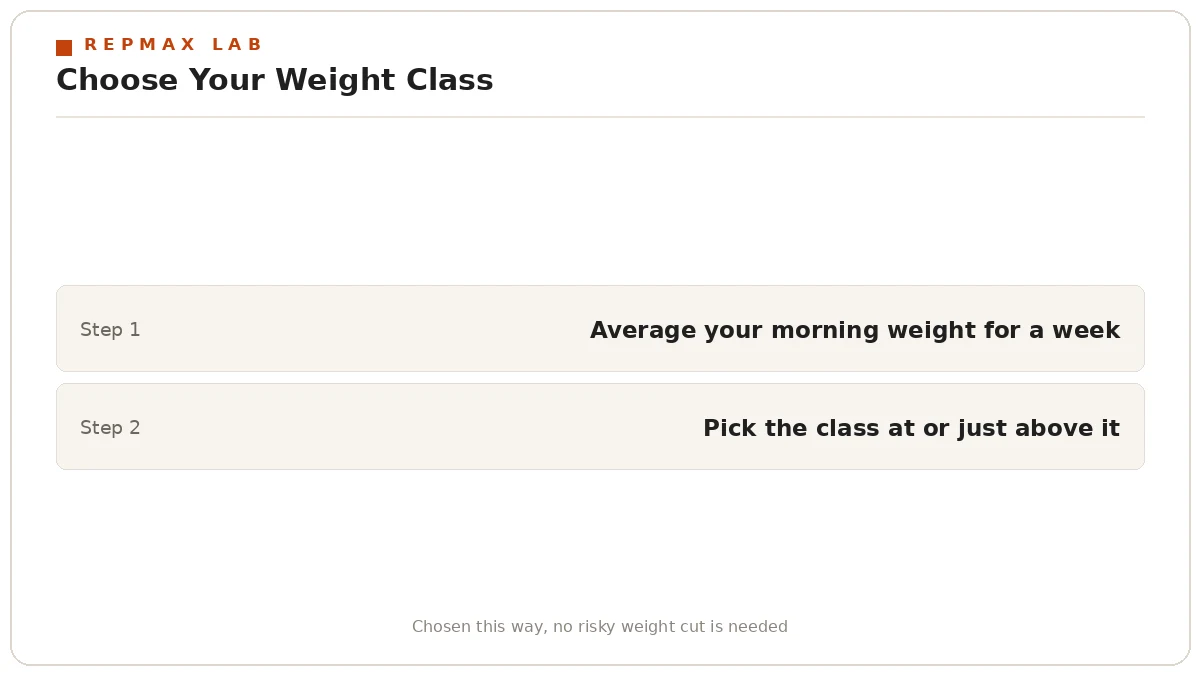
These steps work for any federation.
- Weigh yourself each morning for 7 days, after using the bathroom and before eating, and average the readings.
- Convert the average to kilograms if your federation weighs in kg, by dividing pounds by 2.2046.
- Find the class whose limit sits at or just above your average on your federation’s chart.
- Check the weigh-in window, because a 2-hour window leaves far less recovery time than a 24-hour window.
- Count the weeks until the meet, and plan any bodyweight change with a coach or registered dietitian if you sit near a limit.
- Register in the class you naturally fit for your first meet.
- Move up a class when training adds muscle and you sit above the limit most mornings.
Here’s one bodyweight mapped across systems. A 6 ft (183 cm) man who weighs 196 lb (88.9 kg) each morning fits the IPF 93 kg class (205.0 lb) and the USPA 90 kg class (198.4 lb). In Texas high school terms, he’s a 198 lb lifter.
Height plays a role too. Taller lifters carry a larger frame, and one who struggles to stay under a limit gains more from moving up a class than from repeated cuts.
Water cuts deserve caution. Making weight through a water cut means losing fluid in the days before weigh-in, and that practice belongs only with experienced lifters under qualified guidance, never with teenagers.
Should a Beginner Cut Weight for a First Meet?
No. A first meet is a chance to learn commands and attempt selection, and a weight cut just adds fatigue without real benefit. Warm-up timing takes practice, too. Better to lift at normal bodyweight and post a total, so the choice of a lighter or heavier class rests on real data. For growing high school athletes, rapid weight loss is a poor fit, and parents and coaches keep cuts off the table.
How Lifters Compare Across Weight Classes
Lifters compare strength across weight classes with points formulas such as DOTS, IPF GL Points and the Wilks score, which adjust a competition total for bodyweight so a light lifter and a heavy lifter can be ranked on one list. Meets use these formulas for best lifter awards.
Here are the three main points formulas side by side.
| Formula | Main Use | Notes |
|---|---|---|
| DOTS | Best lifter in several non-IPF federations | Shown on OpenPowerlifting rankings |
| IPF GL Points | Best lifter at IPF meets | Separate coefficients for classic and equipped |
| Wilks Score | Legacy best lifter formula | Still appears in older results |
Points track relative strength, not absolute strength. The heaviest total at a meet usually belongs to a super heavyweight, but the top points score can come from any class.
Free online DOTS calculators take a lifter’s bodyweight and total, ask for sex as well, and then return a single score. Log it after every meet. That running number measures progress after any class change.
Where to Find Powerlifting Records by Weight Class and Age
Find powerlifting records by weight class and age on OpenPowerlifting, a free public database of meet results, and on each federation’s official records page, where records are split by sex, weight class, age division and equipment category. Records change after major meets, so no record figures appear in this guide.
OpenPowerlifting lets users filter rankings by federation, equipment, weight class, sex, age division and year, then sort by total or points. That filter set answers most record questions in under a minute.
Official records sit with each federation. The IPF lists world records on its website, while Powerlifting America keeps a separate set for US lifters. USAPL and the USPA publish their own too, and many federations add state-level records on top.
Raw vs Equipped Records
Yes, raw and equipped records are listed separately. Equipped lifters wear supportive suits and shirts that add weight to the bar, so a raw record and an equipped record in the same class aren’t comparable. The IPF calls raw lifting classic. Some federations split equipped lifting further into single-ply and multi-ply, and federations with tested and untested divisions keep separate records for each.
Frequently Asked Questions
What Weight Class Am I in for Powerlifting?
Your class is the lowest class whose limit equals or exceeds your weigh-in bodyweight. At 170 lb (77.1 kg), for example, a lifter lands in the IPF 83 kg class and the USPA 82.5 kg class.
What Are the Powerlifting Weight Classes in Pounds?
IPF men’s limits in pounds are 130.1, 145.5, 163.1, 183.0, 205.0, 231.5, 264.6 and 264.6+. Women’s limits run 103.6, 114.6, 125.7, 138.9, 152.1, 167.6, 185.2 and 185.2+.
How Many Weight Classes Are There in Powerlifting?
The IPF has 8 open classes per sex, plus one youth-only class each, for 9 per sex. Traditional federations such as the USPA use more classes, and Texas high school boys have 11.
What Is the Best Weight Class for a Beginner?
The best beginner class matches current morning bodyweight with no cut. Competing at natural weight protects performance and builds a clean baseline total for future class decisions.
Do Women’s Classes Differ in USPA Meets?
Yes. USPA women use traditional classes starting at 44 kg (97.0 lb), not the IPF ladder that begins at 47 kg for open lifters. Classes like 67.5 kg and 82.5 kg have no IPF equivalent.
Conclusion
Powerlifting weight classes look simple on a chart. They aren’t. The right class depends on federation, age division, weigh-in window and long-term goals, and since the IPF has already reshaped its women’s classes once while federations keep revising rulebooks, the smartest habit for any US lifter is pulling the current rulebook before every season.
Start in the class that fits your real bodyweight. From there, track your total and DOTS score from meet to meet, and move up only when added muscle makes the next class the stronger choice. Records will keep climbing. OpenPowerlifting and federation records pages, sorted by class and age, show exactly where your numbers stand.