How often should you test your 1RM? By experience, a true one-rep max every 2 to 4 months, at the end of a training block. In between, estimate it every 3 to 6 weeks from a normal hard set, and skip true max tests entirely for your first few months of training.
That’s the short answer, and it’s close to what most coaches will tell you. The harder part is fitting it into a real program without losing a week of training every time you want a number. That’s what this guide covers: how often to test 1RM for your level, where the test goes in a training cycle, and how to keep tabs on your max in between. (If you need a refresher, here’s what a one-rep max is.)
Between tests, the one rep max calculator turns any hard set into an estimate, the training max calculator sets your working weights from it, and the strength standards calculator shows how your lifts compare for your bodyweight.
How often to test 1RM, by experience?
| You are… | Test a true 1RM | Estimate it |
|---|---|---|
| A beginner (first 6 months or so) | Not yet | Every 3–4 weeks from a set of 3–5 |
| An intermediate lifter | Every 8–16 weeks, at the end of a block | Every 3–6 weeks from a top set |
| Advanced, training for strength | 2–4 times a year, when you’re peaking | From top sets, often weekly |
| A competitive powerlifter | At meets, plus maybe once before | From top sets and heavy singles |
| Coming back after 3+ weeks off | Not until you’re near your old numbers | After 2–3 weeks back |
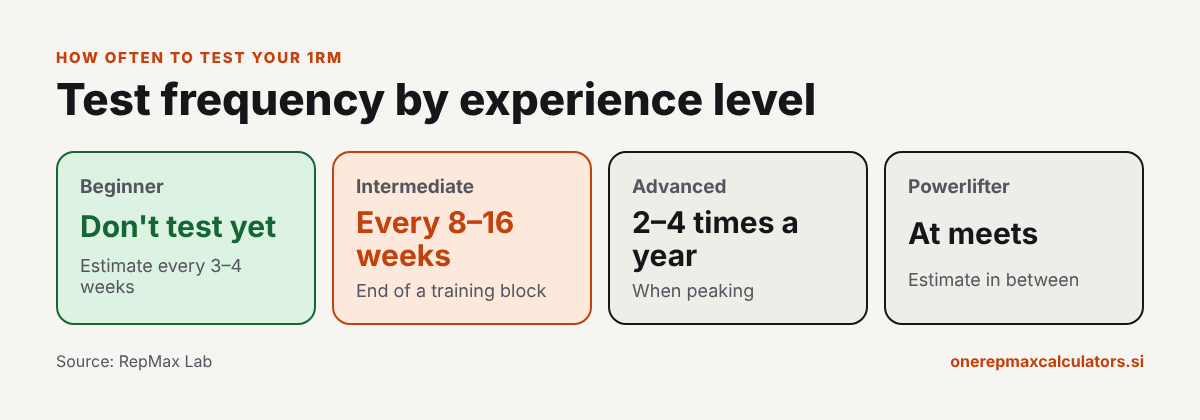
Why does experience change the answer so much? Because of how fast your max moves. A beginner can add weight to the bar almost every session, so a max tested in January is out of date by March. An experienced lifter might add 10 or 20 lb to a lift in a whole year, so testing every month just tells them the same number with extra fatigue on top.
A common question on lifting forums is whether you should be maxing every 5 to 7 weeks. For a newer lifter, maybe. For someone who has trained for years, it rarely shows anything new. As one experienced Reddit user put it, true 1RM PRs “are only going to come a couple times a year” after a few years of training, no matter how often you try.
Where testing fits in your program?
The cleanest way to test is at the end of a block, after an easier week. A simple 12-week layout looks like this:
- Weeks 1–4: first training block.
- Weeks 5–8: second block, a bit heavier.
- Weeks 9–11: third block, heaviest work.
- Week 12: lighter deload for the first few days, then test one or two lifts per session.
- Next cycle: set a new training max from the result (85–90% is typical) and start again.
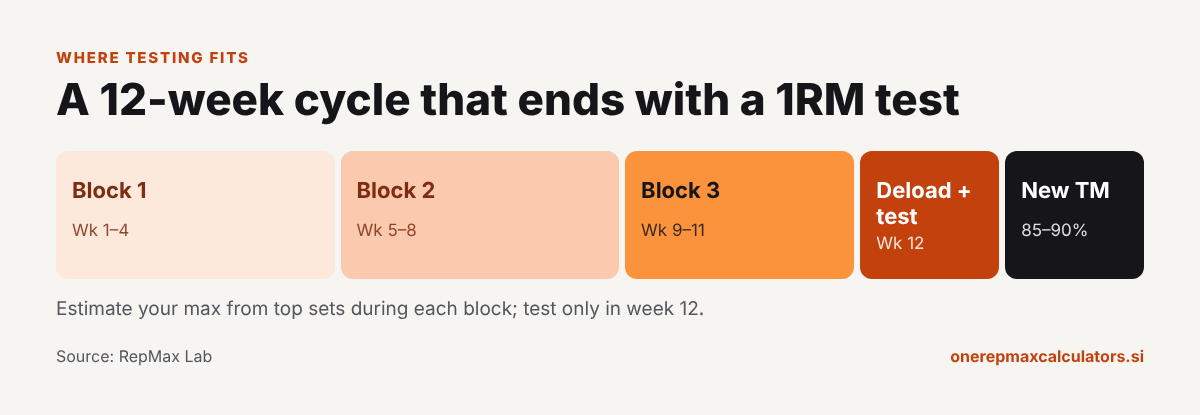
If you’re on a program built around 5-rep maxes or a training max, such as 5×5 or 5/3/1, you don’t have to stop for a max test at all. Plenty of lifters simply estimate their max from the last heavy set of the block and use that to set the next cycle. Testing does cost something, as a Reddit commenter pointed out: usually a few days of normal training. Whether that’s worth it is your call.
How to track your max between tests?
You don’t need to max out to know roughly where you stand. Make your first heavy set of each session count:
- Do a top set of 3–5 reps after warming up.
- Rate how many reps you had left. “Two left in the tank” is fine; just be honest. Lifters are generally reasonable at judging this (Helms et al., 2016).
- Enter the weight, reps, and reps in reserve in the one rep max calculator.
- Save it in My lifts so you can see the trend.
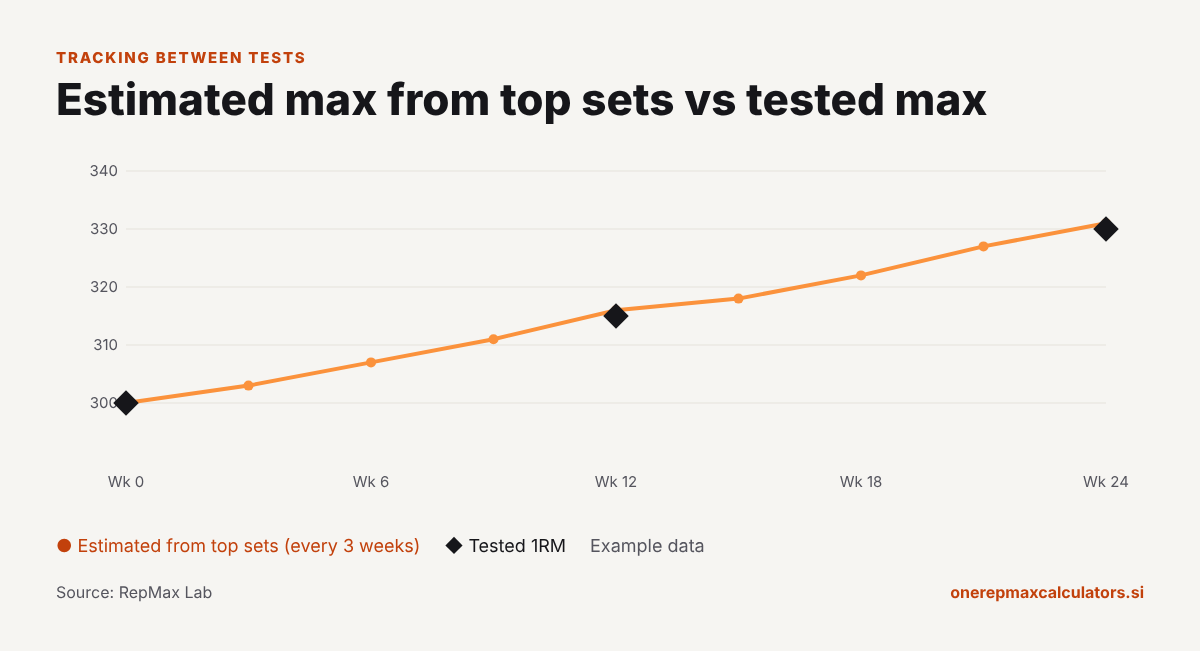
Estimates from sets of 10 reps or fewer are usually close enough to plan training with (Reynolds et al., 2006). If you want the detail, see how accurate 1RM calculators are.
Heavy singles: a check-in, not a test.
There’s a middle ground between estimating and maxing. Every few weeks, work up to a single at around 90% that feels like you had one or two reps left. If it moves fast, you’re on track. If it grinds, your training may need adjusting. It’s quick, it doesn’t wipe you out for days, and it keeps you used to heavy weights so your real max test doesn’t feel unfamiliar.
Signs it’s time to retest:
These signs matter more than any fixed rule for how often to test 1RM.
- Your working sets feel clearly easier. Sets that were hard a month ago now feel like you had reps to spare.
- You’ve set rep PRs. More reps at the same weight usually means a higher max.
- You’ve finished a block or a full program cycle.
- You’ve missed planned reps two sessions running. The max you’re working from may be too high, and an estimate is a gentler way to reset it.
- You’ve had a long break. Estimate first, and test only once you’re back near your old weights.
Why not test more often?
Three reasons. Maximal attempts are the riskiest lifts you’ll do, so fewer of them means fewer chances for something to go wrong. A test day is tiring, and it can take a few days before normal training feels normal again. And strength is built mostly by the training in between, not by the test. If you enjoy testing and recover well, there’s no rule against more frequent PR attempts, but don’t let them crowd out your program.
When you do test?
- Test on a fresh day, ideally after a lighter week.
- Warm up in steps and aim to reach your max within 3–5 attempts, as in the NSCA testing protocol summarised by HPRC. The warm-up calculator builds the sets for you.
- Use a spotter or set safety arms for the bench press and squat.
- Test one or two lifts per session.
- Stop if your technique breaks down. A tested max only counts with the form you’d normally use.
The full step-by-step is in how to test your one-rep max. Tested maxes are also very repeatable from session to session when you test the same way each time (Grgic et al., 2020), so a real change between tests is usually real progress.
After you test:
Take it easy for a day or two, then start your next cycle from a training max rather than your full max. Using 85–90% of your new 1RM leaves room for bad days and steady progress. The training max calculator works it out and gives you every weight for the next four weeks.
In short, how often to test 1RM depends on your training age: rarely as a beginner, then about once per training block.
Frequently asked questions
Should beginners test their 1RM?
Usually not in the first few months. Your strength changes too fast for a tested max to stay useful, so estimate it from a set of 3–5 reps instead.
Is it bad to test your 1RM every week?
For most people, yes. Weekly maximal singles add fatigue and risk without making you stronger. Track an estimate from your top sets instead.
Can I test squat, bench and deadlift on the same day?
Powerlifters do it at meets, but in the gym it’s easier to split them over two or three sessions so each lift gets your full effort.
How long should I wait after testing before training heavy again?
Most lifters are back to normal training within a few days. Start the next block lighter, from a training max.
How often should I test my deadlift?
No more often than your other lifts, and often less. Heavy deadlifts are especially tiring, so many lifters rely on estimates and heavy singles for it.
Sources:
- Haff, G. G., & Triplett, N. T. (Eds.). (2016). Essentials of Strength Training and Conditioning (4th ed.). NSCA / Human Kinetics.
- Human Performance Resources by CHAMP (HPRC). (2022). What is a one-rep max?
- Grgic, J., Lazinica, B., Schoenfeld, B. J., & Pedisic, Z. (2020). Test–retest reliability of the one-repetition maximum (1RM) strength assessment: a systematic review. Sports Medicine – Open, 6, 31. PubMed
- Helms, E. R., Cronin, J., Storey, A., & Zourdos, M. C. (2016). Application of the repetitions in reserve-based rating of perceived exertion scale for resistance training. Strength and Conditioning Journal, 38(4), 42–49. Repository record
- Reynolds, J. M., Gordon, T. J., & Robergs, R. A. (2006). Prediction of one repetition maximum strength from multiple repetition maximum testing and anthropometry. Journal of Strength and Conditioning Research, 20(3), 584–592. PDF