How to increase bench press strength, in short: bench two or three times a week, do about 10 hard sets a week mostly at 70–90% of your one-rep max, add 5 lb (2.5 kg) whenever you complete all your reps, and train the part of the lift where you fail. Good setup comes first: shoulder blades pinched back and down, feet planted, and the bar touching your lower chest. In a controlled 8-week study, trained men who followed this kind of plan added about 10 kg (22 lb) to their bench.
This guide on how to increase bench press shows you how to find your weak point, which fixes match it, and gives you a free 8-week plan with the weights worked out from your own max. Start by getting your number from the bench press max calculator.
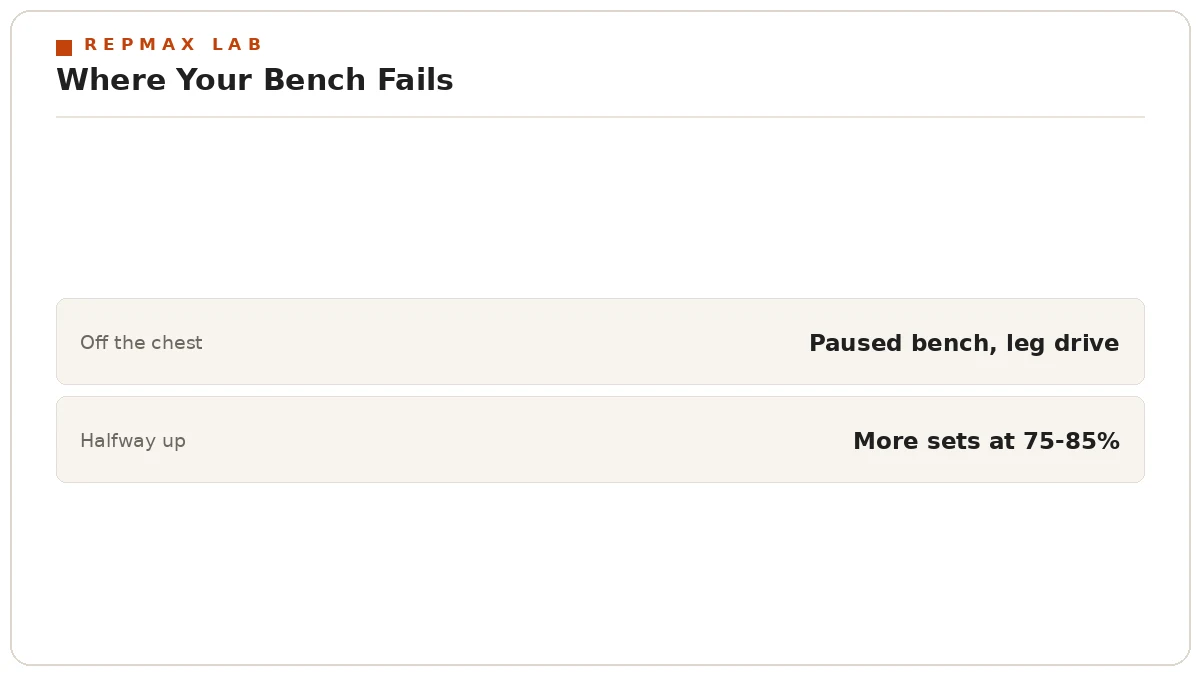
Step 1: Find where your bench fails
Most advice lists the same 10 exercises for everyone. It is faster to watch a heavy set (film it from the side) and see where the bar slows down or stops. That tells you what to train.
| Where it fails | What it usually means | What to add |
|---|---|---|
| Off the chest (first few inches) | Losing tightness at the bottom, or weak chest and front shoulders | Paused bench (1–2 second pause), more upper-back tightness, leg drive |
| Halfway up | Not enough heavy practice; bar drifts toward the feet | More sets at 75–85%, keep pressing up and slightly back |
| Near lockout | Triceps are the limit | Close-grip bench, dips, JM press or heavy triceps pushdowns |
| Bar path wobbles or one side lags | Setup and grip are not repeatable | Same grip mark every set, slower controlled descent |
This mapping is standard coaching practice rather than something proven in a lab, so treat it as a starting point and judge by your own results over a few weeks.
Step 2: Fix your setup (the fastest gain)
When people ask how to increase bench press quickly, the honest answer is usually a better setup. It can add weight in a single session because it lets you use the strength you already have. Run through these five checks before every work set:
- Eyes under the bar. Lie down so the bar is above your eyes, not over your chest. You will not hit the hooks when you press.
- Shoulder blades back and down. Pinch them together and tuck them toward your back pockets. This gives a stable base and a shorter press.
- Feet planted. Feet flat (or on your toes if that is your style), pushed into the floor. Drive through them as you press. Keep your hips on the bench.
- Grip. Slightly wider than shoulders, so your forearms are close to vertical at the bottom. Powerlifting rules cap the grip at 81 cm between the index fingers.
- Bar path. Lower the bar under control to your lower chest, then press up and slightly back toward your face so it finishes over your shoulders.
A moderate arch is normal and safe for most lifters, but it is not required. Keep your elbows tucked a little (not flared straight out) on the way down.
Step 3: Use the right training dose
Three numbers from the research make the biggest difference. Each one is backed by a meta-analysis that pooled many studies:
| Training factor | What works | Evidence |
|---|---|---|
| Load | Most work above 60% of your 1RM, with regular sets at 80–90% | Heavier loads gave bigger 1RM gains than light loads (Schoenfeld et al., 2017, 21 studies) |
| Weekly sets | About 10 or more hard sets of bench per week | 10+ sets per exercise per week beat 5 or fewer for strength (Ralston et al., 2017) |
| Frequency | Bench 2–3 times a week | More frequent training raised strength gains, but not when weekly volume was equal (Grgic et al., 2018, 22 studies) |
| Protein | About 1.6 g per kg of bodyweight per day | Gains in muscle levelled off at about 1.6 g/kg/day (Morton et al., 2018) |
The frequency finding is useful: you do not need to bench every day. Splitting your weekly sets across two or three sessions just makes each set better quality.
To set your loads without testing a max, the RPE calculator converts effort ratings into weights. Lifters who chose loads by RPE gained as much as those using fixed percentages in a study of bench and squat training (Helms et al., 2018).
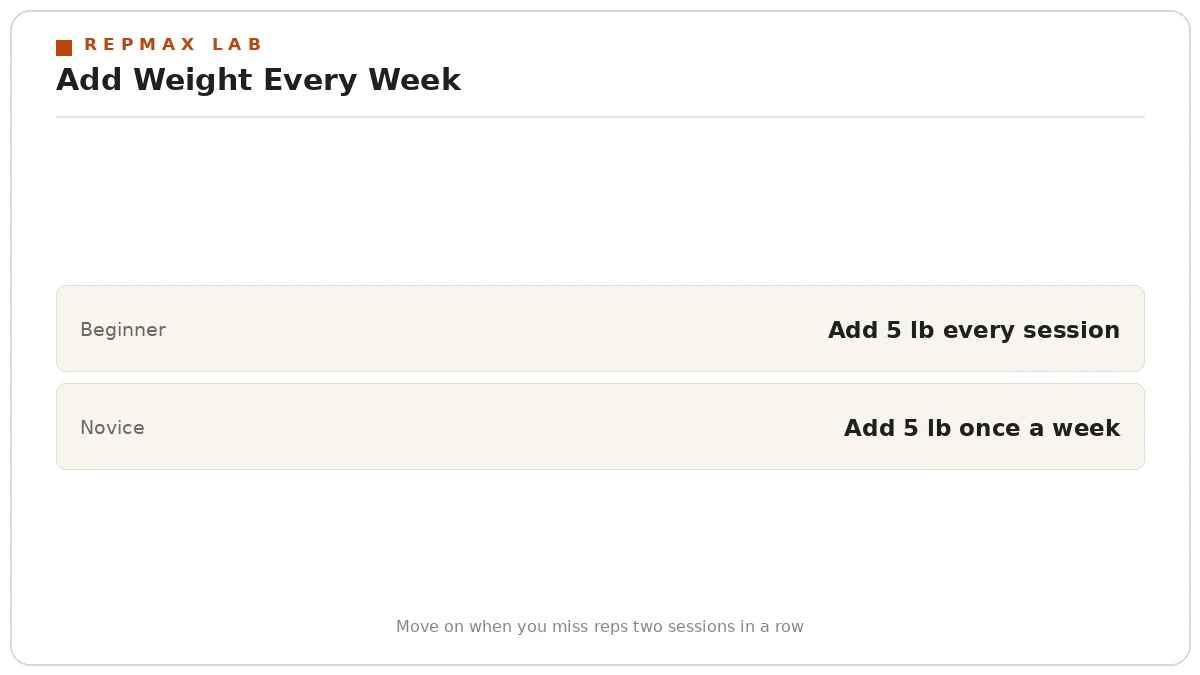
Step 4: Progress the weight every week
Progressive overload, doing a bit more over time, is the core of how to increase bench press over months. Use the rule that fits your level:
| Your level | How to add weight | When to move on |
|---|---|---|
| Beginner (first months) | Add 5 lb (2.5 kg) every bench session if you hit all reps | You miss reps two sessions in a row |
| Novice | Add 5 lb (2.5 kg) once a week | You stall for two or three weeks |
| Intermediate and beyond | Follow a planned block (like the 8-week plan below), then retest your max | After each block |
Small plates matter. If your gym has 1.25 lb or 0.5 kg plates, use them once 5 lb jumps stop working. The plate calculator shows how to load any weight.
Free 8-week plan to increase bench press
This is RepMax Lab’s plan: three bench days a week with a lighter week in the middle and a test at the end. It gives you 10 or more bench sets a week (outside the deload), mostly at 65–90% of your max. The weights below are for a 200 lb (90 kg) max. For your own numbers, multiply your max by each percentage, or use the percentage of 1RM chart.
| Week | Day 1: Heavy | Day 2: Volume | Day 3: Weak point |
|---|---|---|---|
| Week 1 | 4 × 5 at 75% (150 lb / 68 kg) | 4 × 8 at 65% (130 lb / 59 kg) | 3 × 5 paused + 3 × 8 close-grip, RPE 7–8 |
| Week 2 | 4 × 4 at 80% (160 lb / 72 kg) | 4 × 8 at 67.5% (135 lb / 61 kg) | 3 × 5 paused + 3 × 8 close-grip, RPE 7–8 |
| Week 3 | 5 × 3 at 82.5% (165 lb / 74 kg) | 5 × 7 at 70% (140 lb / 63 kg) | 3 × 5 paused + 3 × 8 close-grip, RPE 7–8 |
| Week 4 (deload) | 3 × 5 at 65% (130 lb / 59 kg) | 2 × 8 at 60% (120 lb / 54 kg) | 2 × 5 paused, RPE 6 |
| Week 5 | 4 × 3 at 85% (170 lb / 77 kg) | 4 × 6 at 72.5% (145 lb / 65 kg) | 3 × 5 paused + 3 × 8 close-grip, RPE 7–8 |
| Week 6 | 4 × 2 at 87.5% (175 lb / 79 kg) | 4 × 6 at 75% (150 lb / 68 kg) | 3 × 5 paused + 3 × 8 close-grip, RPE 7–8 |
| Week 7 | 3 × 1–2 at 90% (180 lb / 81 kg) | 3 × 5 at 75% (150 lb / 68 kg) | 3 × 5 paused + 3 × 8 close-grip, RPE 7–8 |
| Week 8 | Warm up and work up to a new 1RM | Rest | Rest |
On Day 3, use the paused bench at about 65–70% and pick the close-grip bench if lockout is your weak spot, or more paused bench if the bottom is. Add rows or pull-ups (3 sets) on two of the days to keep your upper back strong. If you miss reps on a heavy day, keep the same weight next week rather than going up.
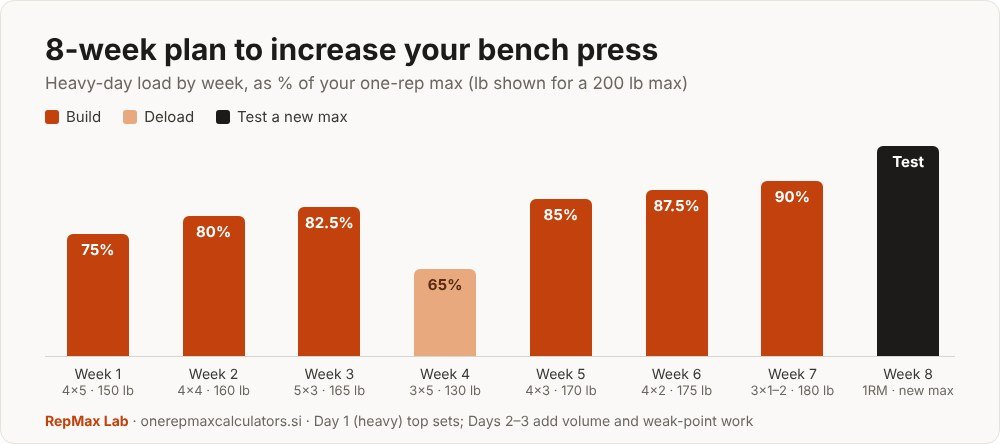
Worked example: 200 lb to a new max
Here is how to increase bench press in practice. Sam benches 200 lb (90 kg) for one rep. In week 1 he does 4 sets of 5 at 150 lb on Day 1 and 4 sets of 8 at 130 lb on Day 2. By week 7 his heavy singles are at 180 lb. In week 8 he warms up with the warm-up calculator and attempts a new max following the steps in how to test your one-rep max.
How much should he expect? In the Helms et al. (2018) study, trained men aged 19–35 added an average of 9.6–10.7 kg (about 21–24 lb) to their bench in 8 weeks of three-days-a-week training. Beginners often gain faster; experienced lifters gain slower.
If you would rather not max out, plug a hard set of 3–5 reps into the bench press max calculator to estimate your new number. For the next block, set loads from a training max of about 90% of your new max.
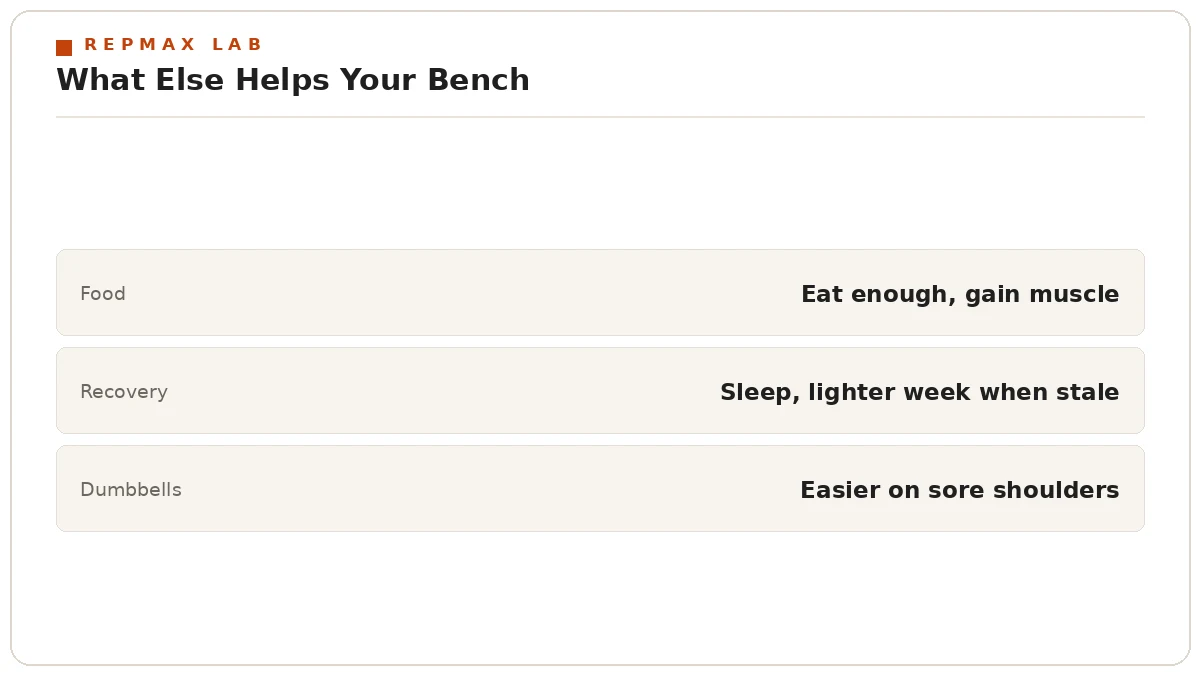
What else helps increase bench press
- Eat enough. Many lifters report their bench went up once they ate more and gained some muscle. Bench press strength depends on chest, shoulder and triceps size, so a slow gain in bodyweight helps if you are lean.
- Sleep and recover. Heavy pressing three times a week only works if you recover between sessions. If every session feels worse, take a lighter week.
- Train with dumbbells too. Dumbbell pressing builds the same muscles and is easier on sore shoulders. See how your dumbbell numbers compare with the dumbbell to barbell bench calculator.
- Use a spotter or safeties. Heavy sets and max attempts should always have a spotter or safety arms set just below your chest.
How do you know it is working?
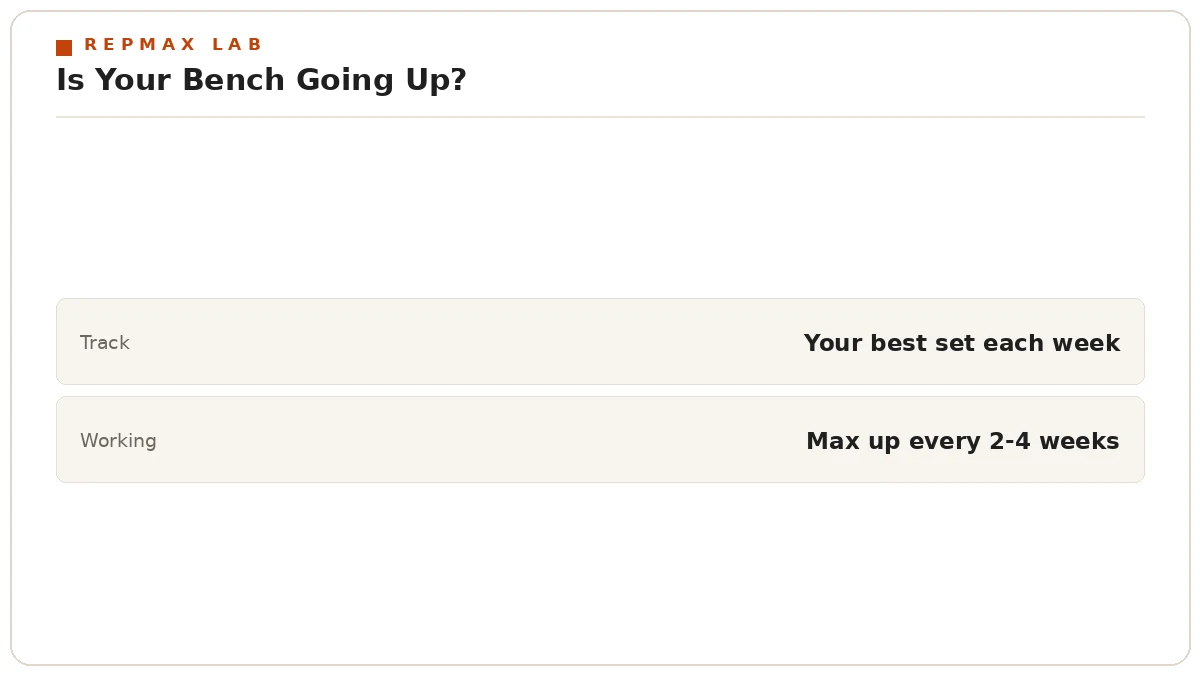
The test of any plan for how to increase bench press is simple: track your best set each week. If your estimated max goes up every 2–4 weeks, the plan is working. Check where you stand against other lifters with the average bench press by age guide or the strength standards calculator.
FAQ
What is the fastest way to increase bench press?
Bench two or three times a week, do most of your work between 70% and 90% of your max, and add 5 lb (2.5 kg) whenever you hit all your reps. Fix your setup first: shoulder blades pinched, feet planted, bar touching your lower chest. In one 8-week study, trained men added about 10 kg (22 lb) to their bench.
How much can I increase my bench press in 2 weeks?
Not much from new muscle. Two weeks is enough to tighten your technique and, if you have been training hard, to rest up before a max attempt, which can show a few extra pounds. Real strength gains take 8 weeks or more.
How do beginners increase bench press?
Bench three times a week with 3 sets of 5 and add 5 lb (2.5 kg) each session while you can complete every rep with good form. When you stall twice in a row, switch to adding weight weekly, then to a planned program like the 8-week plan on this page.
How often should I bench press to get stronger?
Two or three times a week works for most people. A 2018 meta-analysis found strength gains grew with frequency, but the difference went away when total weekly volume was the same, so the main benefit of benching more often is fitting in more good sets.
How many sets of bench press per week?
Aim for about 10 or more hard sets of bench press per week. A meta-analysis of weekly set volume found 10 or more sets per exercise gave bigger strength gains than 5 or fewer.
Is 225 a weak bench?
No. A 225 lb bench is about 1.25 × bodyweight for a 180 lb man, the start of the Advanced band on RepMax Lab’s strength standards. For a 220 lb man, it is about 1 × bodyweight, which is Intermediate.
What exercises increase bench press the most?
Bench press itself, done often and heavy, matters most. After that, pick for where you fail: paused bench for weakness off the chest, close-grip bench and dips for lockout, and rows and pull-ups for a stable upper back.
Related guides
Next steps after this guide on how to increase bench press: read average bench press by age, percentage of 1RM chart and how to test your one-rep max. For your other lifts, see average squat weight, how to increase squat, how to increase deadlift and deadlift standards. Also in this series: how to increase overhead press and how to get better at pull ups.
Sources
- Schoenfeld, B. J., Grgic, J., Ogborn, D., & Krieger, J. W. (2017). Strength and hypertrophy adaptations between low- vs. high-load resistance training: a systematic review and meta-analysis. Journal of Strength and Conditioning Research, 31(12), 3508–3523. PubMed
- Ralston, G. W., Kilgore, L., Wyatt, F. B., & Baker, J. S. (2017). The effect of weekly set volume on strength gain: a meta-analysis. Sports Medicine, 47(12), 2585–2601. PMC5684266
- Grgic, J., Schoenfeld, B. J., Davies, T. B., et al. (2018). Effect of resistance training frequency on gains in muscular strength: a systematic review and meta-analysis. Sports Medicine, 48(5), 1207–1220. PubMed
- Helms, E. R., et al. (2018). RPE vs. percentage 1RM loading in periodized programs matched for sets and repetitions. Frontiers in Physiology, 9, 247. PMC5877330
- Morton, R. W., et al. (2018). A systematic review, meta-analysis and meta-regression of the effect of protein supplementation on resistance training-induced gains in muscle mass and strength in healthy adults. British Journal of Sports Medicine, 52(6), 376–384. PubMed
- British Powerlifting Union, The Bench Press (competition rules, including the 81 cm grip limit).
Weights are rounded to the nearest 5 lb and 1 kg. This guide is general training information, not medical advice. Last reviewed November 12, 2026.