How accurate are 1RM calculators? For a hard set of 3 to 6 reps, a 1RM calculator is usually within about 3–8% of your true max. Push the set past 10 reps and the error grows to 10% or more, and the number tends to come out too high.
That’s the short version. The longer version matters, because “within 5%” on a 300 lb squat is a 15 lb miss, and that’s the difference between a smooth single and getting pinned. Below we’ll show you where the error comes from, how big it gets for different sets and lifts, and how to get a number you can actually train with. If you’re new to the term, start with what a one-rep max is.
Because of that error, many programs set working weights from a training max of 85–90% of the estimate. The training max calculator does this for you, and the squat max calculator and bench press max calculator show the full formula range for your set, so you can see how far to trust it.
How accurate is a 1RM calculator? The short answer by rep count
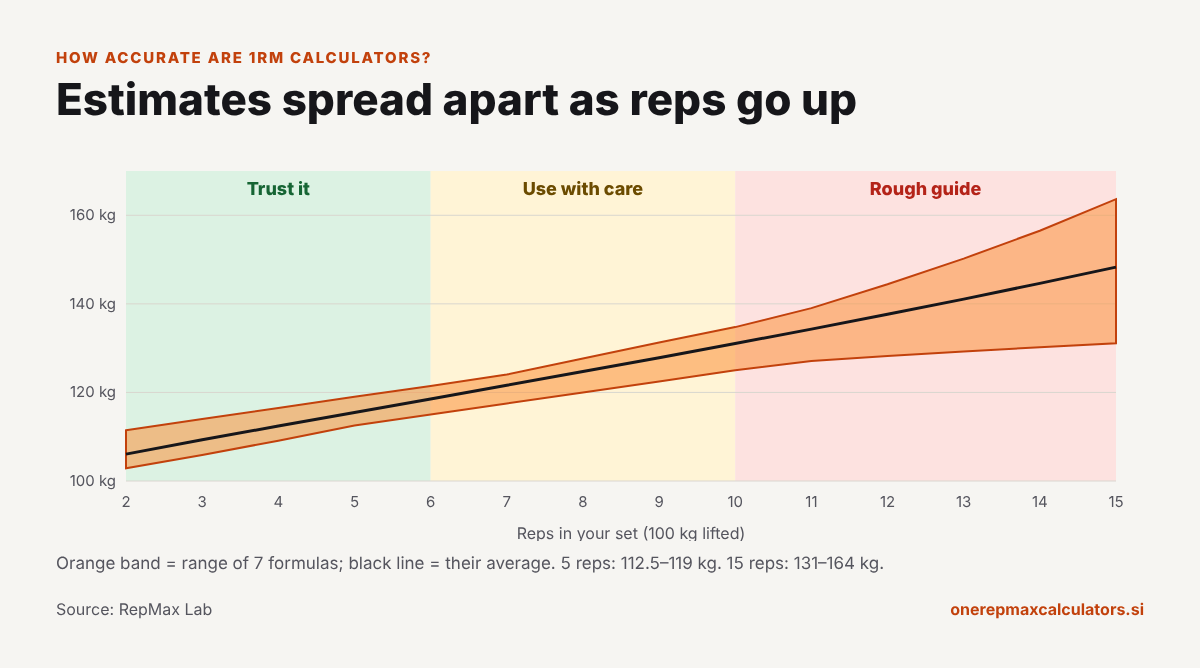
Every calculator uses a prediction formula, and none of them agree perfectly. The easiest way to judge how much to trust a number is to see how far the formulas drift apart. Here’s what the seven formulas in our one-rep max calculator predict for the same 100 kg set:
Reps in your set
Range of 7 formulas
Spread
How much to trust it
3
106–114 kg
7%
High
5
112.5–119 kg
6%
Highest
8
120–128 kg
6%
Good
10
125–135 kg
7%
Fair, and the upper limit
12
128–144 kg
12%
Rough
15
131–164 kg
22%
Barely better than a guess
Chart showing 1RM formula estimates spreading apart as reps increase
Up to about 10 reps, the formulas stay close. After that, they fall apart. A 15-rep set could mean a max anywhere from 131 to 164 kg, which isn’t much use for setting your training weights.
The research lines up with this. In a study of 70 men and women on the bench press and leg press, a 5-rep max predicted 1RM better than a 10- or 20-rep max, and the authors recommended keeping estimates to 10 reps or fewer (Reynolds et al., 2006).
Why your calculated max might be wrong
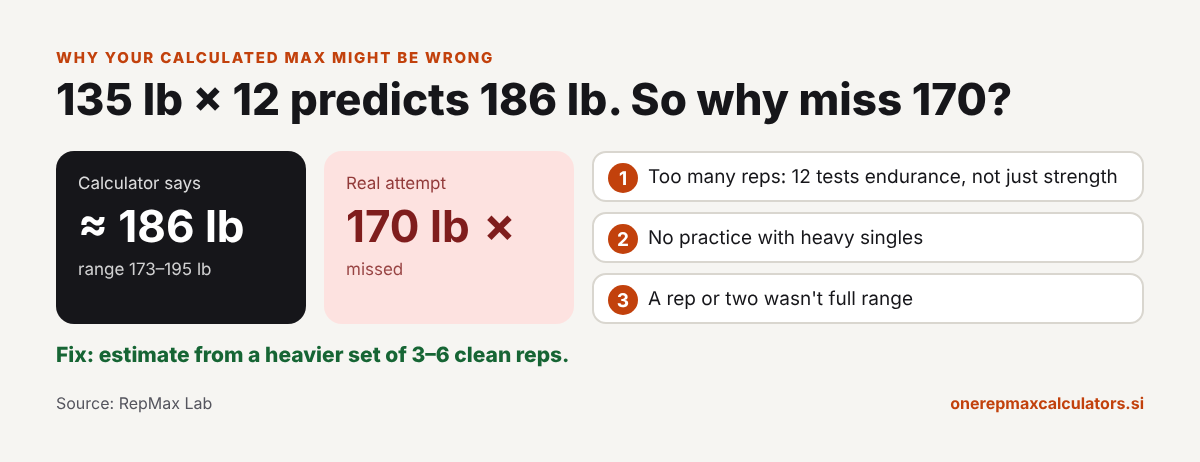
Here’s a question that comes up on lifting forums all the time: “I can bench 135 for 12, so why can’t I hit 170?”
Put 135 lb × 12 into a calculator and you get about 186 lb. The seven formulas range from 173 to 195 lb. So by every formula, 170 should be possible. Yet plenty of people miss it. Three things usually explain it:
Too many reps. A set of 12 tests muscular endurance as much as strength. If you mostly train with lighter weights and higher reps, you’re good at long sets, and the formulas read that as raw strength.
You’ve never practised heavy singles. Lifting 90% or more of your max is a skill. If you never train there, your first real attempt usually comes in under what the math says.
The reps weren’t all clean. A slight bounce off the chest or a half lockout on rep 11 adds a rep the formula treats as real.
Why 135 lb for 12 reps can predict a 186 lb max the lifter cannot lift
The fix is simple: use a heavier set. The same lifter doing 155 lb for 5 would get a much more honest number.
How accuracy changes from lift to lift
Calculators don’t treat every exercise equally well. Most formulas were built and tested on big barbell lifts, so that’s where they work best.
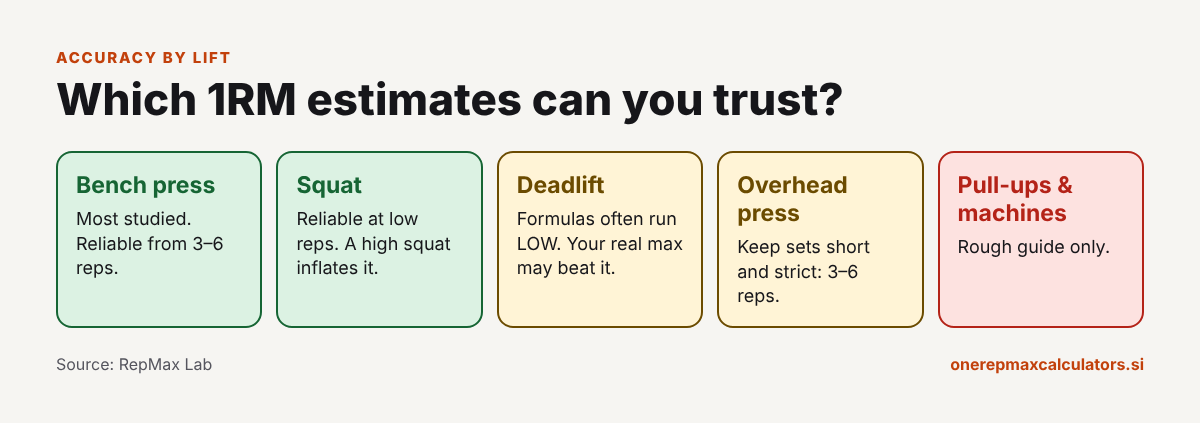
Bench press: the most studied lift for 1RM prediction. Estimates from 3–6 reps are usually reliable (Mayhew et al., 2008).
Squat: reliable at low reps, but depth matters. A set cut a few inches high will inflate the estimate. Use the squat max calculator with full-depth reps.
Deadlift: the odd one out. Research has found that prediction formulas tend to underestimate the deadlift (LeSuer et al., 1997), so your real max may beat the number. More in the deadlift max calculator.
Overhead press: shoulders and triceps tire fast, so keep sets short (3–6 reps) and strict. See the overhead press max calculator.
Pull-ups, machines and isolation lifts: treat the result as a rough guide. Fatigue and technique play a bigger role, and the formulas weren’t designed around them.
Notes on how accurate 1RM estimates are for bench, squat, deadlift and overhead press
What the research says
A handful of studies come up again and again when people talk about 1RM accuracy:
Brzycki (1993) presented one of the most-used formulas and intended it for sets of 10 reps or fewer (Brzycki, 1993).
Reynolds, Gordon and Robergs (2006) found 5-rep sets gave the best predictions and accuracy dropped as reps went up (PDF).
Mayhew and colleagues (2008) tested 103 women before and after 12 weeks of training. Equations were more accurate under 10 reps, and training didn’t throw them off (DOI).
Grgic and colleagues (2020) reviewed 1RM testing itself and found that tested maxes are very consistent from session to session (PubMed). That’s why a tested max is the yardstick everything else is measured against.
One thing to watch for: studies often report how well a formula correlates with real maxes. A high correlation means stronger people get higher estimates, which is true. It doesn’t mean your personal estimate will land within a few pounds. That’s why we show the range, not just the average.
Which 1RM formula is most accurate?
There isn’t one winner. Each formula does well on some lifts and some people, and badly on others. Below 10 reps, the main formulas only differ by a few percent anyway, so the set you choose matters far more than the formula. That’s why our calculator averages seven of them. If you’re curious about the two most common, we compare them in Epley vs Brzycki, and the one rep max formulas guide shows which formula suits your rep range.
How to get a more accurate estimate
Use a set of 3–6 reps. It’s the sweet spot between “heavy enough to reflect strength” and “light enough to do safely”.
Do it fresh. Make it your first hard set after warming up, not your last set of the day.
Be honest about effort. The formulas assume you couldn’t do one more rep. If you had two left, enter them as reps in reserve. For example, 225 × 5 to failure estimates about 260 lb. If you actually had 2 reps left, it’s closer to 274 lb.
Count only clean reps. Same depth, same pause, same lockout you’d use on a real single.
Calibrate to yourself. If you know two rep maxes, compare them. Say your 3-rep max of 185 lb predicts 202 lb, but your 8-rep max of 155 lb predicts only 193 lb. That gap tells you that you have less endurance than the formulas assume, so trust your low-rep sets and treat high-rep estimates as too low.
[IMAGE: 5-rep-set-to-estimate-1rm.jpg] Alt text: “Lifter performing a 5-rep bench press set to estimate a one-rep max”
Should you estimate or test?
Your situation
Best option
Setting weights for your next training block
Estimate from a set of 3–6 reps
Training less than 6 months
Estimate. Your max is changing too fast to test
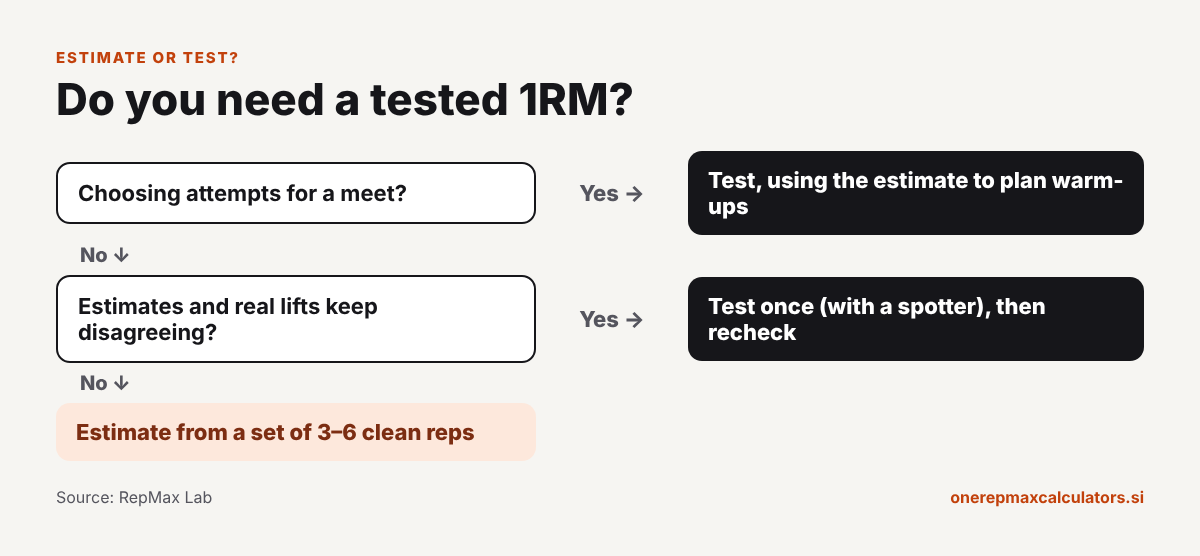
Choosing attempts for a powerlifting meet
Test, using the estimate to plan your warm-ups
Your estimate and your real lifts keep disagreeing
Test once, then use it to check your calculator
No spotter or safety arms
Always estimate
Flowchart for deciding between estimating and testing a one-rep max”
If you do test, open your first attempt at about 90–95% of your estimate rather than going straight for the full number. Our guide on how to test your one-rep max walks through it, and the warm-up calculator builds the sets for you.
Frequently asked questions
What is the most accurate 1RM calculator?
One that uses a low-rep set and shows you a range, not just one number. Averaging several formulas helps, but the biggest gain comes from entering a hard set of 3–6 clean reps.
Are 1RM calculators a lie?
No, but they’re estimates. From a good set they’re close enough to set training weights. From a 15-rep set, they can be off by 20% or more.
Is testing your 1RM pointless?
Not if you compete or need an exact number. For most people training for general strength, estimating every few weeks from a top set gives you nearly the same information with less fatigue and risk.
What rep max is 75% of 1RM?
Most people can do about 10 reps at 75% of their max. See the full rep max chart.
Is the 1RM test reliable?
Yes. Research shows tested maxes are very consistent from one session to the next, provided you warm up the same way and use the same technique.
Why is my estimated max too high?
Usually because the set had too many reps or a few reps weren’t full range. Try a heavier set of 3–5 reps.
Why is my estimated max too low?
You probably stopped short of failure. Add the reps you had left as reps in reserve. On the deadlift, low estimates are common anyway.
Sources
Reynolds, J. M., Gordon, T. J., & Robergs, R. A. (2006). Prediction of one repetition maximum strength from multiple repetition maximum testing and anthropometry. Journal of Strength and Conditioning Research, 20(3), 584–592. PDF
Mayhew, J. L., Johnson, B. D., LaMonte, M. J., Lauber, D., & Kemmler, W. (2008). Accuracy of prediction equations for determining one repetition maximum bench press in women before and after resistance training. Journal of Strength and Conditioning Research, 22(5), 1570–1577. DOI
Brzycki, M. (1993). Strength testing: predicting a one-rep max from reps-to-fatigue. Journal of Physical Education, Recreation & Dance, 64(1), 88–90. Publication page
Grgic, J., Lazinica, B., Schoenfeld, B. J., & Pedisic, Z. (2020). Test–retest reliability of the one-repetition maximum (1RM) strength assessment: a systematic review. Sports Medicine – Open, 6, 31. PubMed
LeSuer, D. A., McCormick, J. H., Mayhew, J. L., Wasserstein, R. L., & Arnold, M. D. (1997). The accuracy of prediction equations for estimating 1-RM performance in the bench press, squat, and deadlift. Journal of Strength and Conditioning Research, 11(4), 211–213.