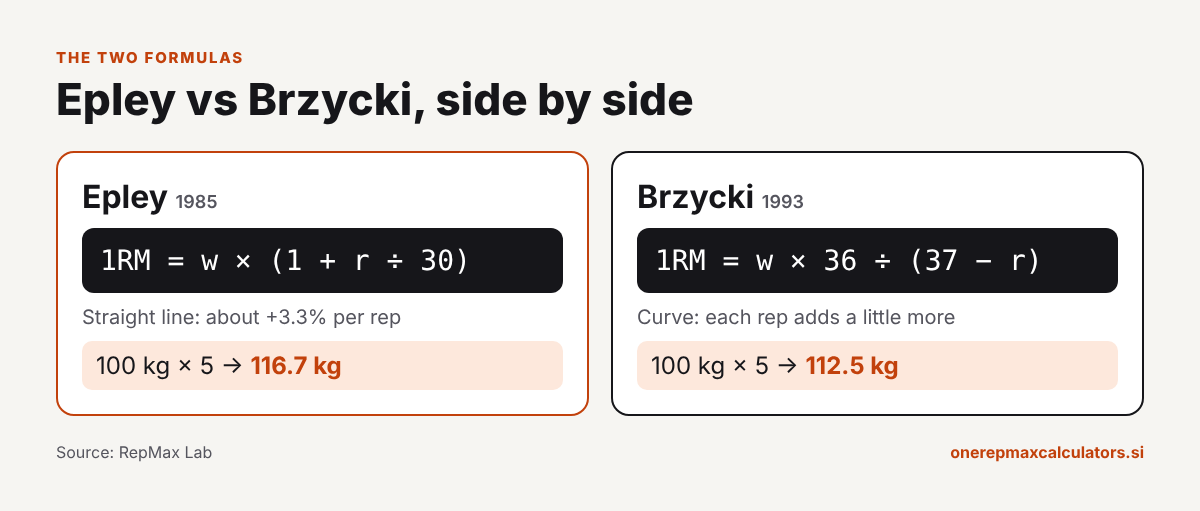
Epley vs Brzycki: the Epley formula is 1RM = weight × (1 + reps ÷ 30), and the Brzycki formula is 1RM = weight × 36 ÷ (37 − reps). They are the two most common ways to estimate your one-rep max from a set of reps. Below 10 reps Epley gives the higher number, at exactly 10 reps they match, and above 10 Brzycki climbs faster. For 225 lb × 5, Epley says 262.5 lb and Brzycki 253.1 lb.
For a normal set of 3 to 8 reps, the difference is small: usually 2–4%. So which one you pick matters less than most comparison articles suggest. What matters more is the set you put into it. Below we show both formulas side by side, what the gap means for your actual training weights, and when each one makes sense. (If you’re new to the term, start with what a one-rep max is.)
To see both formulas, and five more, side by side for your own set, use the one rep max calculator, or go straight to the bench press max calculator or the squat max calculator.
The two formulas
| Formula | Equation | In plain words |
|---|---|---|
| Epley (1985) | 1RM = weight × (1 + reps ÷ 30) | Adds about 3.3% of the weight for every rep |
| Brzycki (1993) | 1RM = weight × 36 ÷ (37 − reps) | Each extra rep adds a little more than the last |
Epley is a straight line. Every rep adds the same amount, which makes it easy to do in your head: a set of 3 is about 10% above the weight you lifted, a set of 6 about 20%.
Brzycki is a curve. You’ll sometimes see it written as 1RM = weight ÷ (1.0278 − 0.0278 × reps). That’s the same formula rearranged. Because the bottom of the fraction shrinks as reps go up, the estimate rises faster and faster, and the formula stops making sense as you approach 37 reps. Brzycki presented it for sets of 10 reps or fewer (Brzycki, 1993).
Brzycki formula
The Brzycki formula estimates your one-rep max as 1RM = weight × 36 ÷ (37 − reps). Matt Brzycki published it in 1993, and it works best for sets of 10 reps or fewer. Example: 225 lb for 5 reps → 225 × 36 ÷ 32 = 253.1 lb. Calculate your max with the Brzycki formula only.
Epley formula
The Epley formula is 1RM = weight × (1 + reps ÷ 30). It adds about 3.3% of the weight for every rep you complete. Example: 225 lb for 5 reps → 225 × (1 + 5 ÷ 30) = 262.5 lb. Calculate your max with the Epley formula only.
Epley vs Brzycki: side-by-side results
Here’s what each formula estimates for a 225 lb set at different rep counts:
| 225 lb for | Epley | Brzycki | Difference (lb) |
|---|---|---|---|
| 2 | 240 | 231.4 | +8.6 |
| 3 | 247.5 | 238.2 | +9.3 |
| 4 | 255 | 245.5 | +9.5 |
| 5 | 262.5 | 253.1 | +9.4 |
| 6 | 270 | 261.3 | +8.7 |
| 8 | 285 | 279.3 | +5.7 |
| 10 | 300 | 300 | 0 |
| 12 | 315 | 324 | −9 |
| 15 | 337.5 | 368.2 | −30.7 |
And for a 100 kg set:
| 100 kg for | Epley | Brzycki | Difference (kg) |
|---|---|---|---|
| 2 | 106.7 | 102.9 | +3.8 |
| 3 | 110 | 105.9 | +4.1 |
| 4 | 113.3 | 109.1 | +4.2 |
| 5 | 116.7 | 112.5 | +4.2 |
| 6 | 120 | 116.1 | +3.9 |
| 8 | 126.7 | 124.1 | +2.5 |
| 10 | 133.3 | 133.3 | 0 |
| 12 | 140 | 144 | −4 |
| 15 | 150 | 163.6 | −13.6 |
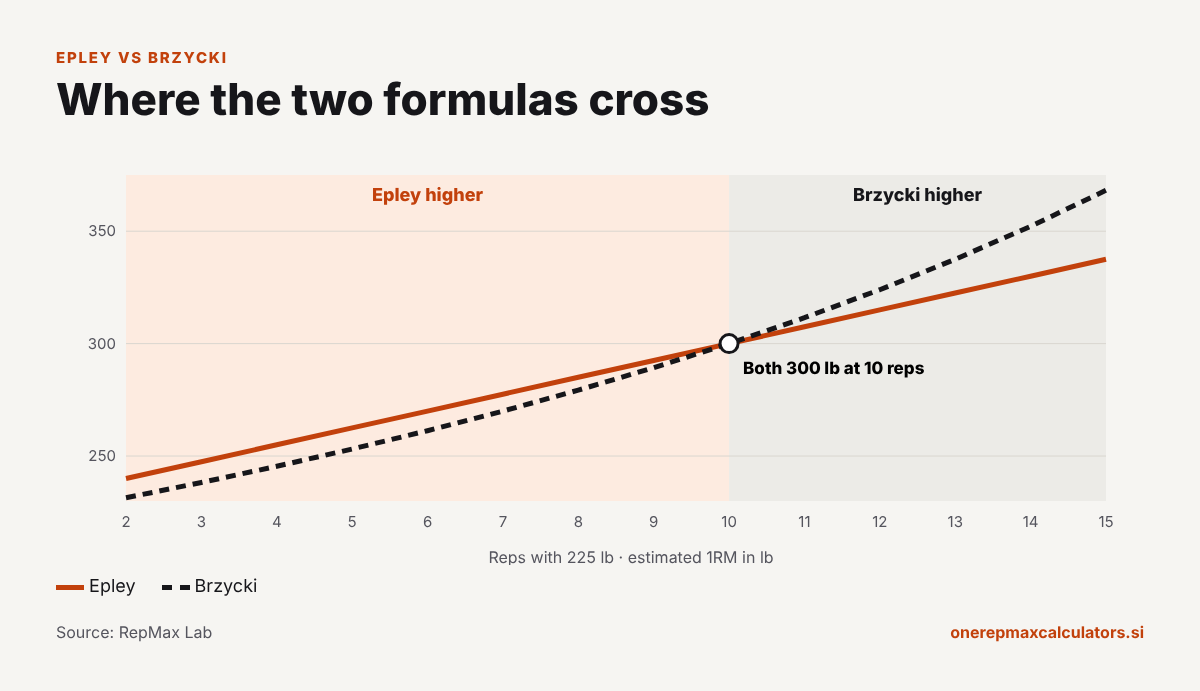
Three things stand out. Up to 8 reps, Epley is higher by 2–4%. At 10 reps the two give exactly the same answer, because both multiply the weight by 1.333. After that they split fast. At 15 reps, Brzycki is more than 30 lb higher on a 225 lb set, which is a sign that neither number should be trusted that far out.
Want to see the same set through all seven common formulas? Our one rep max calculator shows Epley, Brzycki and five others, plus their average.
Common sets worked out
Looking up a set you just did? Here are both formulas and the average of all seven that our one rep max calculator uses.
| Set | Epley | Brzycki | Average of 7 formulas |
|---|---|---|---|
| 145 lb × 6 | 174.0 lb | 168.4 lb | 171.9 lb |
| 145 lb × 8 | 183.7 lb | 180.0 lb | 180.8 lb |
| 165 lb × 2 | 176.0 lb | 169.7 lb | 175.0 lb |
| 175 lb × 5 | 204.2 lb | 196.9 lb | 202.1 lb |
| 315 lb × 3 | 346.5 lb | 333.5 lb | 344.3 lb |
For any other set, enter it in the calculator, or use the max charts on the bench, squat and deadlift pages.
Does the formula change your training?
A lifter on the T-Nation forum put it well: Epley gave him about 285 lb, Brzycki about 280, “not a huge difference, but it adds up when you’re calculating working sets”. So let’s see how much it adds up to.
Take 225 lb for 5 reps. Epley says 262.5 lb and Brzycki says 253 lb. If your program calls for sets at 85%:
- With Epley: 0.85 × 262.5 ≈ 223 lb, so you’d load 225.
- With Brzycki: 0.85 × 253 ≈ 215 lb.
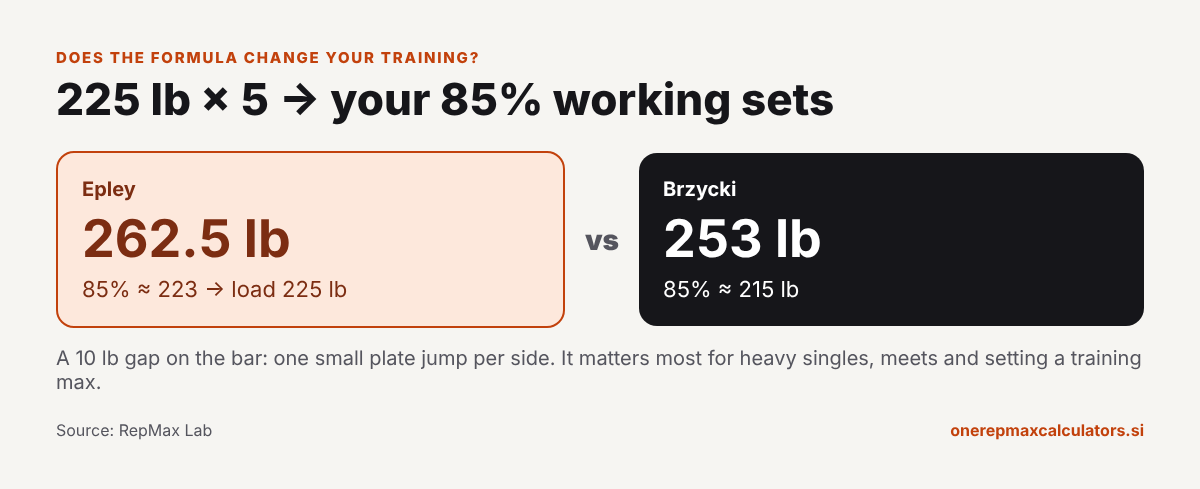
That’s a 10 lb gap on the bar, or one small plate jump on each side. For most training, that’s within the normal day-to-day swing in how strong you feel. Where it does matter: heavy singles and doubles near your max, peaking for a meet, and choosing a training max for a program like 5/3/1. In those cases, a lower estimate is the safer starting point.
How accurate are Epley and Brzycki?
Neither formula is consistently more accurate. Studies that compared prediction equations against tested maxes found that results depend on the lift, the lifter and above all the rep count. Predictions are best from lower-rep sets and get worse as reps go up; one study found a 5-rep max gave the best estimates and recommended staying at 10 reps or fewer (Reynolds et al., 2006). Another found equations were more accurate when sets had fewer than 10 reps, even after 12 weeks of training (Mayhew et al., 2008).
In practice, both formulas assume your set went to true failure with clean reps. If you stopped with reps left or let your form slide at the end, no formula will fix that. We cover this in more detail in how accurate 1RM calculators are.
What about one rep?
Here’s an odd quirk. Put 225 lb × 1 into the Epley formula and it says your max is 232.5 lb. That makes no sense: if you lifted 225 once, your max is 225. Brzycki gets this right (36 ÷ 36 = 1). Most calculators, including ours, simply return the weight you lifted when you enter one rep, whichever formula is selected.
Epley, Brzycki, Lombardi and the rest
These two aren’t the only options. For the same 225 lb × 5 set, here’s what five other common formulas say:
| Formula | Estimate for 225 lb × 5 |
|---|---|
| Brzycki / O’Conner | 253 lb |
| Lander | 256 lb |
| Wathen | 262 lb |
| Epley | 262.5 lb |
| Lombardi | 264 lb |
| Mayhew | 268 lb |
| Average of all 7 | 260 lb |
At 5 reps they fall within about 15 lb of each other. That’s why averaging several formulas is a reasonable default. It smooths out each formula’s lean without you having to pick a favourite.
Which one should you use?
| If you… | Use |
|---|---|
| Want a conservative number for heavy work or a training max | Brzycki |
| Want quick mental math in the gym | Epley (add about 3.3% per rep) |
| Did a set of 10 reps | Either: they give the same answer |
| Did more than 10 reps | Neither with confidence. Redo the estimate with a heavier set |
| Aren’t sure | The average of several formulas |
[IMAGE: checking-1rm-calculator-between-sets.jpg] Alt text: “Lifter checking a 1RM calculator between bench press sets”
If you’re using the result to plan training, the training max calculator takes an estimate, applies 85–90%, and gives you every weight for a four-week wave. For what each rep count means as a percentage, see the rep max chart.
Frequently asked questions
What is the Brzycki formula?
1RM = weight × 36 ÷ (37 − reps). Matt Brzycki published it in 1993 for estimating a max from sets of 10 reps or fewer.
What is the Epley formula?
1RM = weight × (1 + reps ÷ 30). It adds about 3.3% of the weight per rep, so a set of 5 at 200 lb estimates about 233 lb.
Is Brzycki stricter than Epley?
Below 10 reps, yes: it gives a lower estimate. Above 10 reps it’s the other way round.
How accurate is the Brzycki formula?
It’s reasonably accurate for sets of 10 reps or fewer taken to failure, and gets less reliable as reps rise. No formula is accurate for every lifter.
How accurate is the Epley formula?
About the same as Brzycki for normal sets. It tends to give slightly higher numbers below 10 reps, and it overstates a single rep unless the calculator corrects for it.
What is the most accurate one rep max formula?
There isn’t a single winner. Use a hard set of 3–6 reps and average several formulas; that does more for accuracy than choosing one.
Sources:
- Epley, B. (1985). Poundage chart. Boyd Epley Workout. Body Enterprises.
- Brzycki, M. (1993). Strength testing: predicting a one-rep max from reps-to-fatigue. Journal of Physical Education, Recreation & Dance, 64(1), 88–90. Publication page
- Reynolds, J. M., Gordon, T. J., & Robergs, R. A. (2006). Prediction of one repetition maximum strength from multiple repetition maximum testing and anthropometry. Journal of Strength and Conditioning Research, 20(3), 584–592. PDF
- Mayhew, J. L., Johnson, B. D., LaMonte, M. J., Lauber, D., & Kemmler, W. (2008). Accuracy of prediction equations for determining one repetition maximum bench press in women before and after resistance training. Journal of Strength and Conditioning Research, 22(5), 1570–1577. DOI