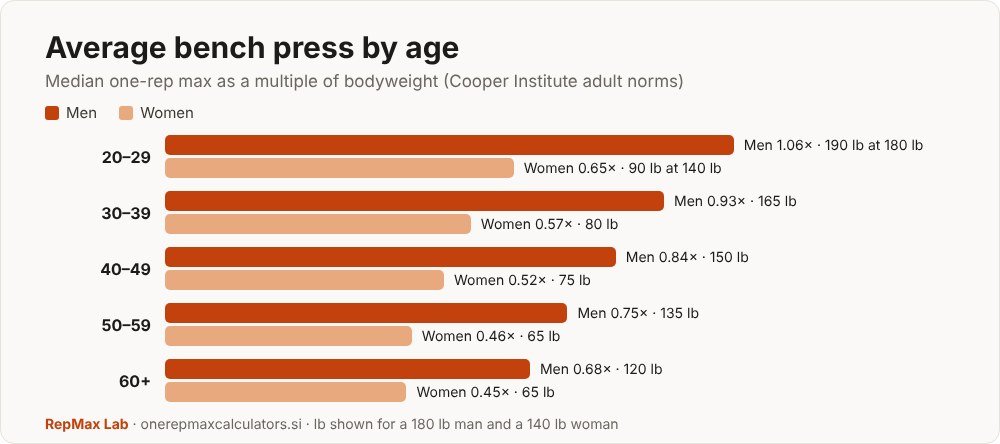
Average bench press by age, in short: a man in his 20s benches about 1.06 × bodyweight: roughly 190 lb (87 kg) for a 180 lb man. For a woman in her 20s it is about 0.65 × bodyweight, or 90 lb (42 kg) at 140 lb. Both drop by roughly 10% per decade after 30. These are the medians from the Cooper Institute’s adult fitness norms, the most widely used general-population bench press data.
Below are the full average bench press by age tables, with bodyweight and percentiles, for men and women. There is also a second set of numbers for people who train seriously, because “average” means something very different in a gym full of lifters. To see where your own lift lands, use the strength standards calculator or estimate your max first with the bench press max calculator.
Average bench press by age for men
Bench press divided by bodyweight, with what that means for a 180 lb (82 kg) man. The 50th percentile is the average; the middle half of men fall between the 25th and 75th.
| Age | Average (50th percentile) | At 180 lb bodyweight | At 82 kg | Middle half (25th–75th) |
|---|---|---|---|---|
| 20–29 | 1.06 × bodyweight | 190 lb | 87 kg | 160–225 lb |
| 30–39 | 0.93 × bodyweight | 165 lb | 76 kg | 145–195 lb |
| 40–49 | 0.84 × bodyweight | 150 lb | 69 kg | 135–175 lb |
| 50–59 | 0.75 × bodyweight | 135 lb | 62 kg | 120–155 lb |
| 60+ | 0.68 × bodyweight | 120 lb | 56 kg | 110–140 lb |
Weights are rounded to the nearest 5 lb. A man in his 20s who benches 225 lb at 180 lb bodyweight (1.25 ×) is right at the 75th percentile: stronger than about three in four men his age.
Average bench press for women by age
The same data for women, shown for a 140 lb (64 kg) bodyweight.
| Age | Average (50th percentile) | At 140 lb bodyweight | At 64 kg | Middle half (25th–75th) |
|---|---|---|---|---|
| 20–29 | 0.65 × bodyweight | 90 lb | 42 kg | 75–110 lb |
| 30–39 | 0.57 × bodyweight | 80 lb | 36 kg | 70–90 lb |
| 40–49 | 0.52 × bodyweight | 75 lb | 33 kg | 65–85 lb |
| 50–59 | 0.46 × bodyweight | 65 lb | 29 kg | 55–75 lb |
| 60+ | 0.45 × bodyweight | 65 lb | 29 kg | 55–75 lb |
For women, a bodyweight bench press is rare: it sits right at the 95th percentile for women in their 20s (1.01 × bodyweight) and above it for every older group.
Average bench press by bodyweight
Because strength scales with size, bodyweight matters as much as age. These are the 50th-percentile benches for three age groups, rounded to 5 lb.
Men
| Bodyweight | Age 20–29 | Age 30–39 | Age 40–49 |
|---|---|---|---|
| 130 lb (59 kg) | 140 lb | 120 lb | 110 lb |
| 150 lb (68 kg) | 160 lb | 140 lb | 125 lb |
| 170 lb (77 kg) | 180 lb | 160 lb | 145 lb |
| 190 lb (86 kg) | 200 lb | 175 lb | 160 lb |
| 210 lb (95 kg) | 225 lb | 195 lb | 175 lb |
| 230 lb (104 kg) | 245 lb | 215 lb | 195 lb |
| 250 lb (113 kg) | 265 lb | 230 lb | 210 lb |
Women
| Bodyweight | Age 20–29 | Age 30–39 | Age 40–49 |
|---|---|---|---|
| 110 lb (50 kg) | 70 lb | 65 lb | 55 lb |
| 125 lb (57 kg) | 80 lb | 70 lb | 65 lb |
| 140 lb (64 kg) | 90 lb | 80 lb | 75 lb |
| 155 lb (70 kg) | 100 lb | 90 lb | 80 lb |
| 170 lb (77 kg) | 110 lb | 95 lb | 90 lb |
| 185 lb (84 kg) | 120 lb | 105 lb | 95 lb |
| 200 lb (91 kg) | 130 lb | 115 lb | 105 lb |
Average bench press for people who lift
The Cooper numbers describe adults who came in for a fitness assessment, not people who bench every week. For a “gym” average, the best large dataset is drug-tested powerlifting competitions: a 2024 study of 809,986 competition entries (van den Hoek et al., 2024). The median competitive bench press, as a multiple of bodyweight:
| Age | Men (median) | Women (median) |
|---|---|---|
| 18–35 | 1.56 × | 0.96 × |
| 36–59 | 1.51 × | 0.90 × |
| 60–79 | 1.23 × | 0.72 × |
| 80+ | 0.93 × | 0.55 × |
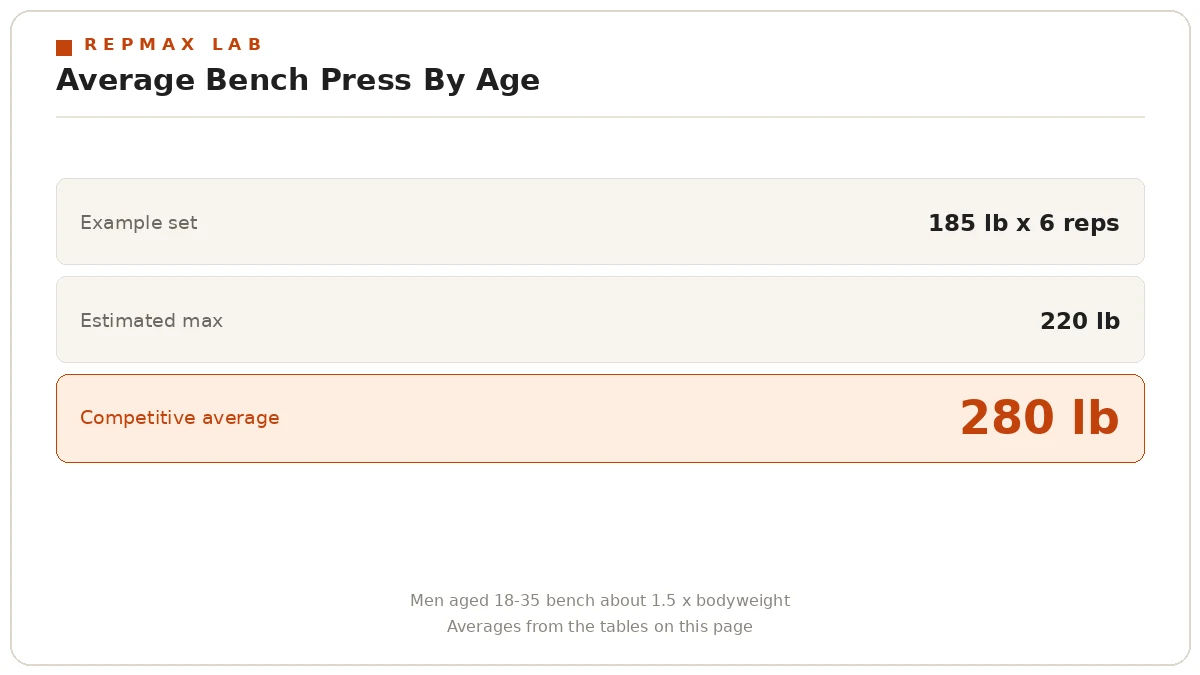
So the typical competitive man aged 18–35 benches about one and a half times his bodyweight: 280 lb at 180 lb. That is a long way above the general-population average, and it is why online “average” numbers vary so much. Notice too that trained lifters lose strength far more slowly with age: the competitive median barely moves between 18–35 and 36–59.
How much should you bench?
For most people a sensible target is to move from the general-population average toward the trained-lifter numbers over a few years of steady training. As a rough guide for men, about 1 × bodyweight is a solid intermediate bench and 1.25 × is advanced. For women, about 0.5 × is intermediate and 0.75 × is advanced. Those are the bands our strength standards calculator uses, and it shows exactly how far you are from the next level.
If you haven’t tested a max recently, don’t. Enter a recent hard set into the bench press max calculator: 185 lb for 6 reps, for example, works out to about 220 lb.
Why these numbers are averages, not targets
- Machine vs barbell. The Cooper Institute norms were measured on a guided bench press machine (Universal DVR), not a free barbell. Barbell numbers can differ, so treat the tables as a close guide rather than an exact match.
- Who was tested. Cooper Clinic patients are self-selected adults, not a random sample of the population. Powerlifters are the opposite extreme.
- Bench style. A paused competition bench is harder than a touch-and-go rep with a big arch.
- Bodyweight. Ratios slightly favour lighter people; heavier lifters bench more in absolute terms but less per pound of bodyweight.
Frequently asked questions
What is a good bench press for a 30-year-old man?
The average man aged 30–39 benches about 0.93 × bodyweight (165 lb at 180 lb). Around 1.1 × puts you near the top quarter for that age group, and 1.25 × or more is advanced by most standards.
What is the average bench press for a woman?
About 0.65 × bodyweight for women in their 20s and 0.57 × in their 30s: 90 lb and 80 lb for a 140 lb woman. Women who compete in powerlifting average closer to 0.96 × bodyweight.
Is a 225 lb bench above average?
Yes, for almost everyone. For a 180 lb man in his 20s it is about the 75th percentile, and for men over 30 it is well into the top quarter. At 225 lb bodyweight it is closer to average for a man in his 20s.
Does bench press strength really drop with age?
In the general population, the average bench falls by roughly a third between the 20s and 60+. People who keep training lose much less: competitive lifters aged 36–59 bench almost as much relative to bodyweight as those aged 18–35.
Related guides
Compare your other lifts: average squat weight by age and deadlift standards by age and bodyweight. Want a bigger number? Follow the steps and free 8-week plan in how to increase bench press.
Sources
- The Cooper Institute (2013). Physical Fitness Assessments and Norms for Adults and Law Enforcement. Dallas, TX. Bench press ratio norms by age and sex; Cooper Clinic patients, Universal DVR machine.
- van den Hoek, D. J., et al. (2024). Normative data for the squat, bench press and deadlift exercises in powerlifting: data from 809,986 competition entries. Journal of Science and Medicine in Sport, 27(10), 734–742. doi:10.1016/j.jsams.2024.07.005. Medians as tabulated by FitnessNorms.
Weights in lb are rounded to the nearest 5 lb and kg to the nearest whole kilogram. Last reviewed November 3, 2026.