How to increase deadlift strength, in short: pull heavy once a week and lighter once a week, keep most heavy work between 75% and 90% of your one-rep max, add 5–10 lb (2.5–5 kg) whenever you finish every rep, and train the part of the pull where you fail. A tight setup comes first: bar over the middle of your foot, slack pulled out of the bar and your back locked in before the plates leave the floor.
This guide on how to increase deadlift strength shows you how to find your weak point, which fixes match it, and gives you a free 8-week plan with the weights worked out from your own max. Start by getting your number from the deadlift max calculator.
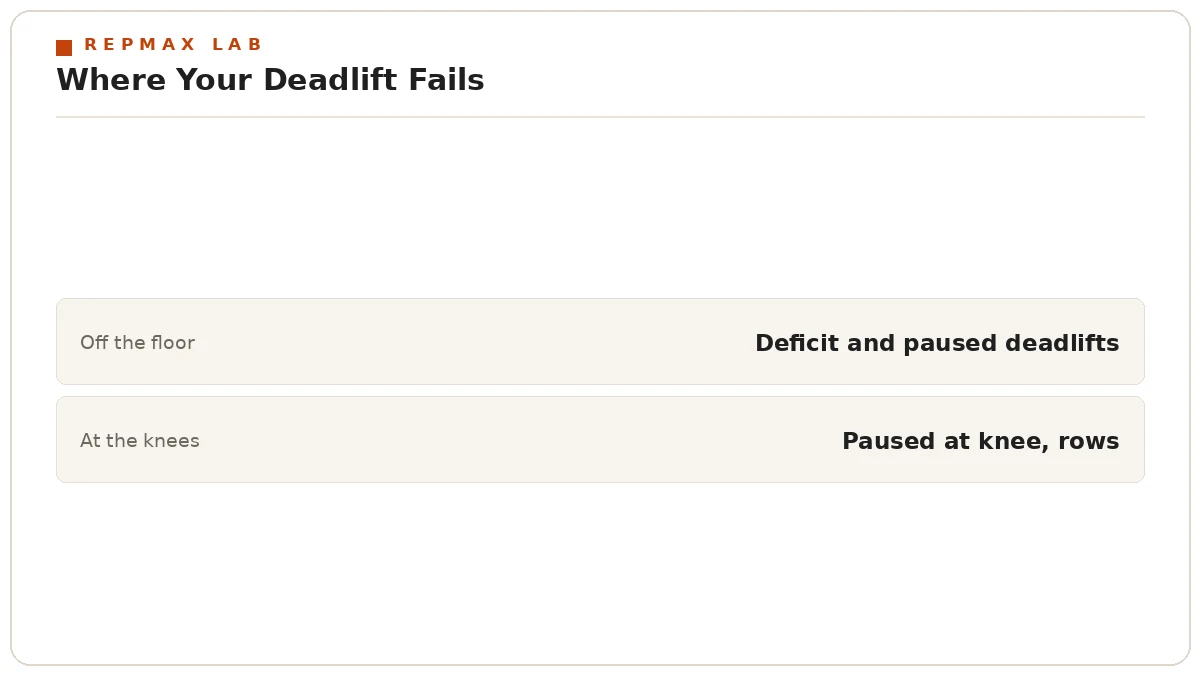
Step 1: Find where your deadlift fails
Film a heavy set from the side. Watch where the bar slows down and what your body does just before.
| Where it fails | What it usually means | What to add |
|---|---|---|
| Off the floor | Weak legs, or hips starting too high or too low | Deficit deadlifts (stand on a 1–2 inch plate), paused deadlifts just off the floor, front squats |
| At the knees | Bar drifting forward, or a weak upper or lower back | Paused deadlifts at the knee, rows, keep the bar touching your legs |
| At lockout | Hips and glutes not finishing the pull | Romanian deadlifts, block pulls from just below the knee, hip thrusts |
| Bar slips from your hands | Grip is the limit, not your legs or back | Chalk, hook grip, heavy holds at the top, farmer’s carries |
| Back rounds as you pull | Lost tightness before the bar left the floor | Lighter sets with a 1-second pause to set your lats before each pull |
This mapping is standard coaching practice rather than something tested in a lab, so treat it as a starting point and judge it by your results over a few weeks.
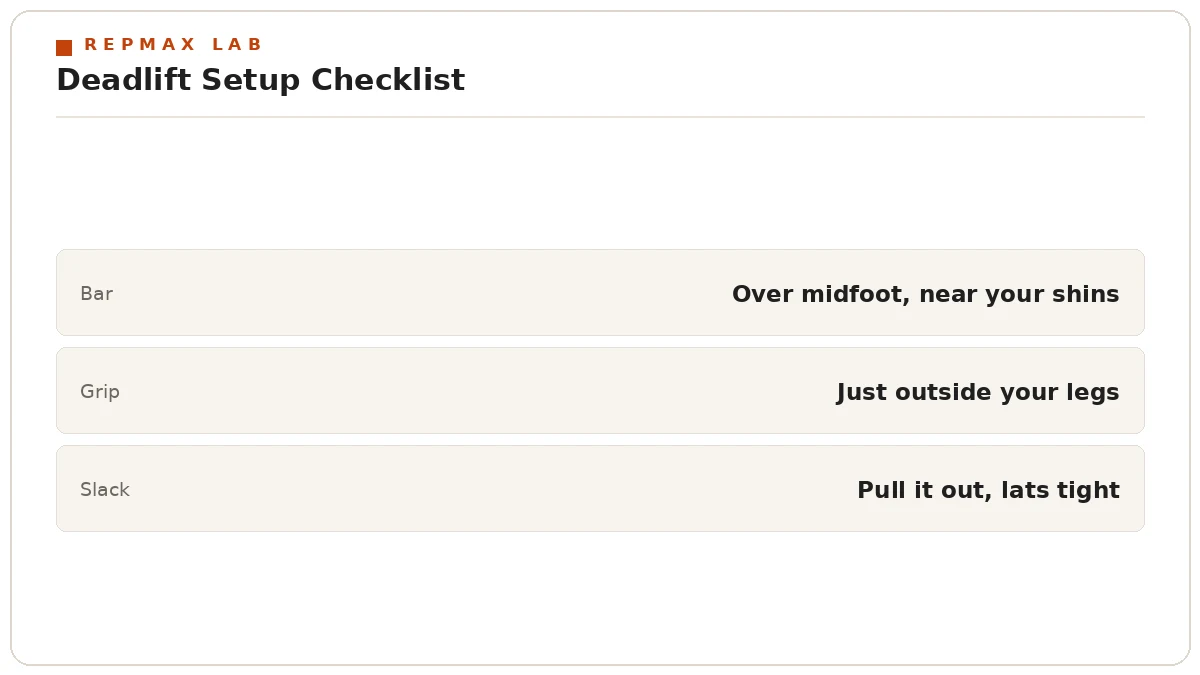
Step 2: Fix your setup
When people ask how to increase deadlift numbers quickly, the honest answer is usually a better setup. It lets you use the strength you already have. Run through these checks before every heavy pull:
- Bar over midfoot. Stand so the bar sits over the middle of your foot, about an inch from your shins.
- Grip just outside your legs. Arms straight and hanging down, hands close to your legs so the bar travels the shortest distance.
- Pull the slack out. Pull up on the bar until you hear the plates click against the bar, without lifting it yet. Squeeze your armpits down to lock in your lats.
- Brace. Big breath into your belly, tighten your stomach around it and hold it until the lift is done.
- Push the floor away. Drive with your legs and keep the bar touching your legs all the way up. Finish standing tall with your knees and hips locked, without leaning back.
Powerlifting rules allow any grip, but the bar must not drop on the way up or rest on your thighs. Training to that standard keeps your progress honest.
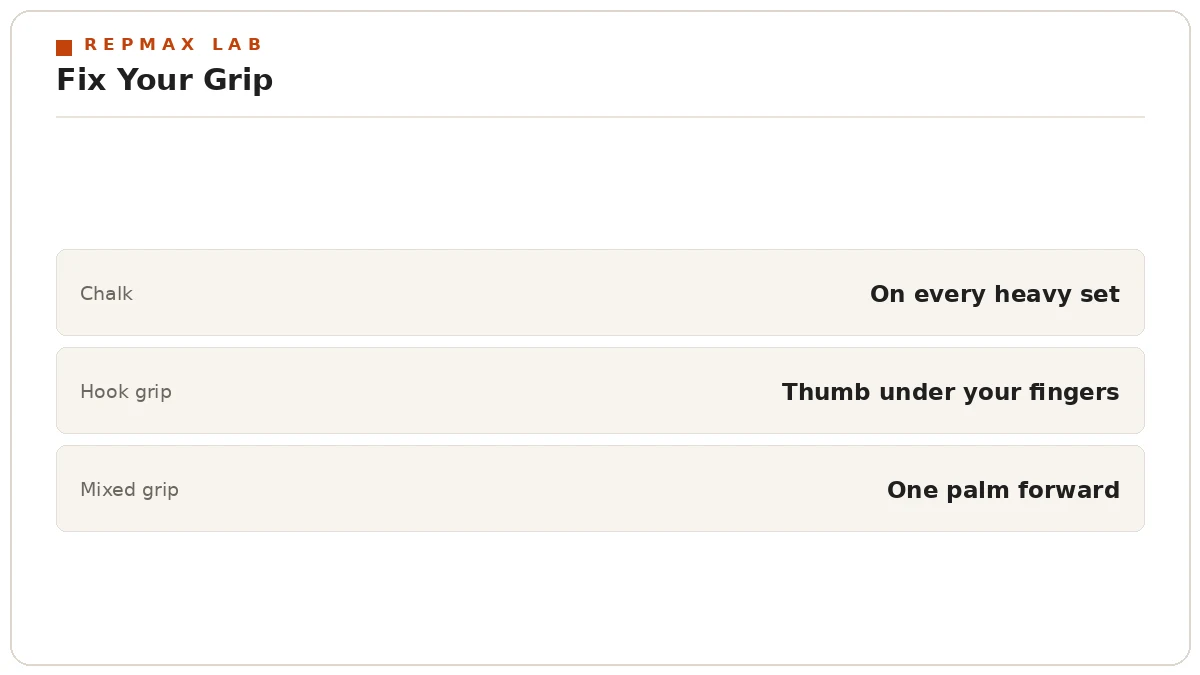
Step 3: Don’t let your grip hold you back
If the bar rolls out of your hands before your legs and back are tired, your grip is the limit. Use chalk on every heavy set. Learn the hook grip (thumb under your fingers) or a mixed grip (one palm forward, one back). Save lifting straps for lighter back-off sets so your grip still gets trained on heavy days.
Step 4: Use the right training dose
The deadlift is very tiring, so most lifters pull heavy only once a week. The research on strength still applies. Each row below is backed by a meta-analysis:
| Training factor | What works | Evidence |
|---|---|---|
| Load | Most work above 60% of your 1RM, with regular sets at 80–90% | Heavier loads gave bigger 1RM gains than light loads (Schoenfeld et al., 2017, 21 studies) |
| Weekly sets | About 10 or more hard sets a week for your back and hips, counting deadlift variations and Romanian deadlifts | 10+ sets per exercise per week beat 5 or fewer for strength, including multi-joint lifts (Ralston et al., 2017) |
| Frequency | Pull twice a week: one heavy day, one lighter day | More frequent training raised strength in multi-joint lifts, but not when weekly volume was equal (Grgic et al., 2018, 22 studies) |
| Protein | About 1.6 g per kg of bodyweight per day | Gains in muscle levelled off at about 1.6 g/kg/day (Morton et al., 2018) |
The frequency finding means the second day is mainly a way to fit in more quality sets, not magic. Keep it lighter so you recover for the next heavy day.
To pick loads without testing a max, the RPE calculator turns effort ratings into weights. In a study of squat and bench training, lifters who chose loads by RPE gained as much as those using fixed percentages (Helms et al., 2018).
Step 5: Progress the weight and recover
Progressive overload, doing a bit more over time, is the core of how to increase deadlift strength over months. Use the rule that fits your level:
| Your level | How to add weight | When to move on |
|---|---|---|
| Beginner (first months) | Add 10 lb (5 kg) each deadlift session if every rep is clean | You miss reps two sessions in a row |
| Novice | Add 5–10 lb (2.5–5 kg) once a week | You stall for two or three weeks |
| Intermediate and beyond | Follow a planned block (like the 8-week plan below), then retest your max | After each block |
Sleep at least 7 hours a night, the minimum sleep scientists recommend for adults (Watson et al., 2015). If your lower back still feels beaten up by your next heavy day, cut the second day’s sets in half that week. The plate calculator shows how to load each new weight.
Free 8-week plan to increase deadlift
This is RepMax Lab’s plan: two pull days a week, a lighter week in the middle and a test at the end. The weights below are for a 315 lb (143 kg) max. For your own numbers, multiply your max by each percentage, or use the percentage of one rep max chart.
| Week | Day 1: Heavy deadlift | Day 2: Weak point (3 days later) |
|---|---|---|
| Week 1 | 3 × 5 at 75% (235 lb / 107 kg) | Weak-point pull 3 × 3 at 65% (205 lb / 93 kg) + Romanian deadlifts 3 × 8, RPE 7–8 |
| Week 2 | 4 × 4 at 80% (250 lb / 114 kg) | Weak-point pull 3 × 3 at 67.5% (215 lb / 97 kg) + Romanian deadlifts 3 × 8, RPE 7–8 |
| Week 3 | 4 × 3 at 82.5% (260 lb / 118 kg) | Weak-point pull 4 × 3 at 70% (220 lb / 100 kg) + Romanian deadlifts 3 × 8, RPE 7–8 |
| Week 4 (deload) | 2 × 5 at 65% (205 lb / 93 kg) | Weak-point pull 2 × 3 at 60% (190 lb / 86 kg) + Romanian deadlifts 2 × 8, RPE 6 |
| Week 5 | 3 × 3 at 85% (270 lb / 122 kg) | Weak-point pull 4 × 2 at 72.5% (230 lb / 104 kg) + Romanian deadlifts 3 × 8, RPE 7–8 |
| Week 6 | 3 × 2 at 87.5% (275 lb / 125 kg) | Weak-point pull 3 × 2 at 75% (235 lb / 107 kg) + Romanian deadlifts 3 × 8, RPE 7–8 |
| Week 7 | 2 × 1–2 at 90% (285 lb / 129 kg) | Weak-point pull 2 × 2 at 70% (220 lb / 100 kg) + Romanian deadlifts 3 × 8, RPE 7–8 |
| Week 8 | Warm up and work up to a new 1RM | Rest |
Pick the Day 2 pull from your weak point in Step 1: deficit deadlifts if you fail off the floor, paused deadlifts at the knee if you fail mid-way, or block pulls if you fail at lockout. Use straps on Romanian deadlifts if your grip gives out before your hamstrings. If you miss reps on a heavy day, repeat that weight next week.
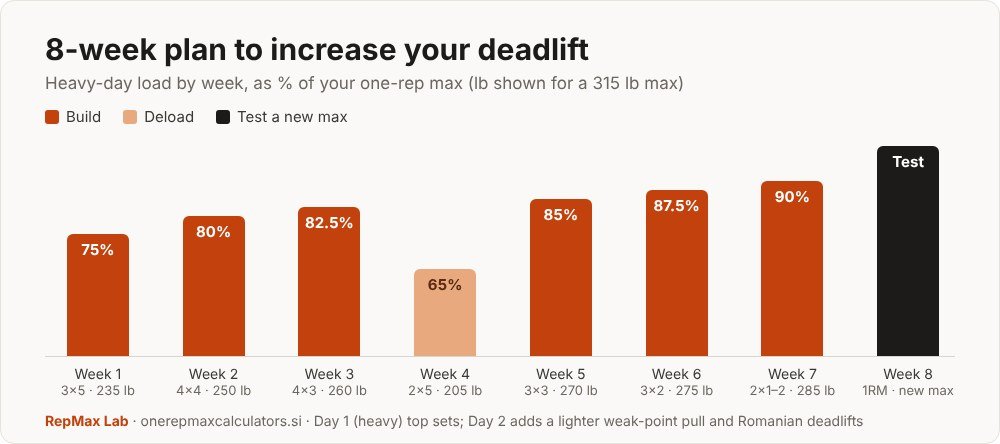
Worked example: 315 lb to a new max
Here is how to increase deadlift strength in practice. Alex pulls 315 lb (143 kg) for one rep and fails at the knees. In week 1 he does 3 sets of 5 at 235 lb on Day 1. On Day 2 he does 3 sets of 3 paused deadlifts at 205 lb, then Romanian deadlifts. By week 7 his heavy singles are at 285 lb. In week 8 he warms up with the warm-up calculator and attempts a new max, following how to test your one-rep max.
If you would rather not max out, enter a hard set of 3–5 reps into the deadlift max calculator to estimate your new number. For the next block, set loads from a training max of about 90% of your new max.
What else helps increase deadlift strength
- Build your squat too. Stronger legs help you break the bar off the floor. Follow how to increase squat alongside this plan.
- Row heavy. A strong upper back keeps the bar close and your back from rounding.
- Wear flat shoes. Thin, flat soles shorten the pull and keep you stable. Soft running shoes make it harder to push the floor away.
- Stop sets when form breaks. End the set when your back starts to round. Grinding ugly reps adds fatigue more than strength.
How do you know it is working?
The test of any plan for how to increase deadlift strength is simple: track your best set each week. If your estimated max goes up every 2–4 weeks, it is working. See where you stand with the deadlift standards guide or the strength standards calculator.
FAQ
How can I increase my deadlift fast?
Fix your setup first: bar over midfoot, slack pulled out of the bar and lats tight before the plates leave the floor. Then pull heavy once a week, add a lighter second pull day aimed at your weak point, and add 5–10 lb (2.5–5 kg) whenever you complete every rep.
Why is my deadlift not improving?
The usual causes are pulling to a max too often, too little weekly work for the back and hips, a grip that fails before your legs and back do, or a setup that changes from rep to rep. Film a heavy set and check where the bar slows down.
How much should a 70 kg man deadlift?
On RepMax Lab’s strength standards, about 70 kg (1 × bodyweight) is Novice, 105 kg (1.5 ×) is Intermediate and 140 kg (2 ×) is Advanced for a 70 kg man.
Is a 140 kg deadlift good?
It depends on your bodyweight. At 70 kg bodyweight, 140 kg is 2 × bodyweight, the start of the Advanced band for men. At 90 kg it is about 1.56 ×, which is Intermediate.
Is a 100 kg deadlift good?
For a 70 kg man it is about 1.43 × bodyweight, just under Intermediate. For a 60 kg woman it is about 1.67 ×, which is Advanced on RepMax Lab’s standards.
Can you increase your deadlift by 100 lb in 90 days?
A beginner sometimes can, because early gains come fast. A trained lifter usually can’t. In an 8-week study, trained men added about 10 kg (22 lb) to the bench and 14–17 kg (31–38 lb) to the squat, so expect deadlift gains in a similar range, not 100 lb.
Should I pull sumo or conventional?
Both are legal in powerlifting. Try each for a few weeks with the same effort and keep the one where your estimated max rises faster and your back feels better.
Related guides
Next steps after this guide on how to increase deadlift: read deadlift standards, percentage of one rep max chart and how to test your one-rep max. For your other lifts, follow how to increase squat and how to increase bench press. Also in this series: how to increase overhead press and how to get better at pull ups.
Sources
- Schoenfeld, B. J., Grgic, J., Ogborn, D., & Krieger, J. W. (2017). Strength and hypertrophy adaptations between low- vs. high-load resistance training: a systematic review and meta-analysis. Journal of Strength and Conditioning Research, 31(12), 3508–3523. PubMed
- Ralston, G. W., Kilgore, L., Wyatt, F. B., & Baker, J. S. (2017). The effect of weekly set volume on strength gain: a meta-analysis. Sports Medicine, 47(12), 2585–2601. PMC5684266
- Grgic, J., Schoenfeld, B. J., Davies, T. B., et al. (2018). Effect of resistance training frequency on gains in muscular strength: a systematic review and meta-analysis. Sports Medicine, 48(5), 1207–1220. PubMed
- Helms, E. R., et al. (2018). RPE vs. percentage 1RM loading in periodized programs matched for sets and repetitions. Frontiers in Physiology, 9, 247. PMC5877330
- Morton, R. W., et al. (2018). A systematic review, meta-analysis and meta-regression of the effect of protein supplementation on resistance training-induced gains in muscle mass and strength in healthy adults. British Journal of Sports Medicine, 52(6), 376–384. PubMed
- Watson, N. F., et al. (2015). Recommended amount of sleep for a healthy adult: a joint consensus statement of the American Academy of Sleep Medicine and Sleep Research Society. Sleep, 38(6), 843–844. PMC4434546
- British Powerlifting Union, The Deadlift (competition rules).
Weights are rounded to the nearest 5 lb and 1 kg. This guide is general training information, not medical advice. Last reviewed November 16, 2026.