How to increase overhead press strength, in short: press twice a week, do about 10 hard sets a week mostly at 70–90% of your one-rep max, add weight in small 2.5–5 lb (1–2.5 kg) steps, and build your triceps and upper back. A tight setup comes first: stomach and glutes braced, bar stacked over your wrists and elbows, and your head moving out of the way so the bar travels straight up.
This guide on how to increase overhead press strength shows you how to find your weak point, which fixes match it, and gives you a free 8-week plan with the weights worked out from your own max. Start by getting your number from the overhead press max calculator.
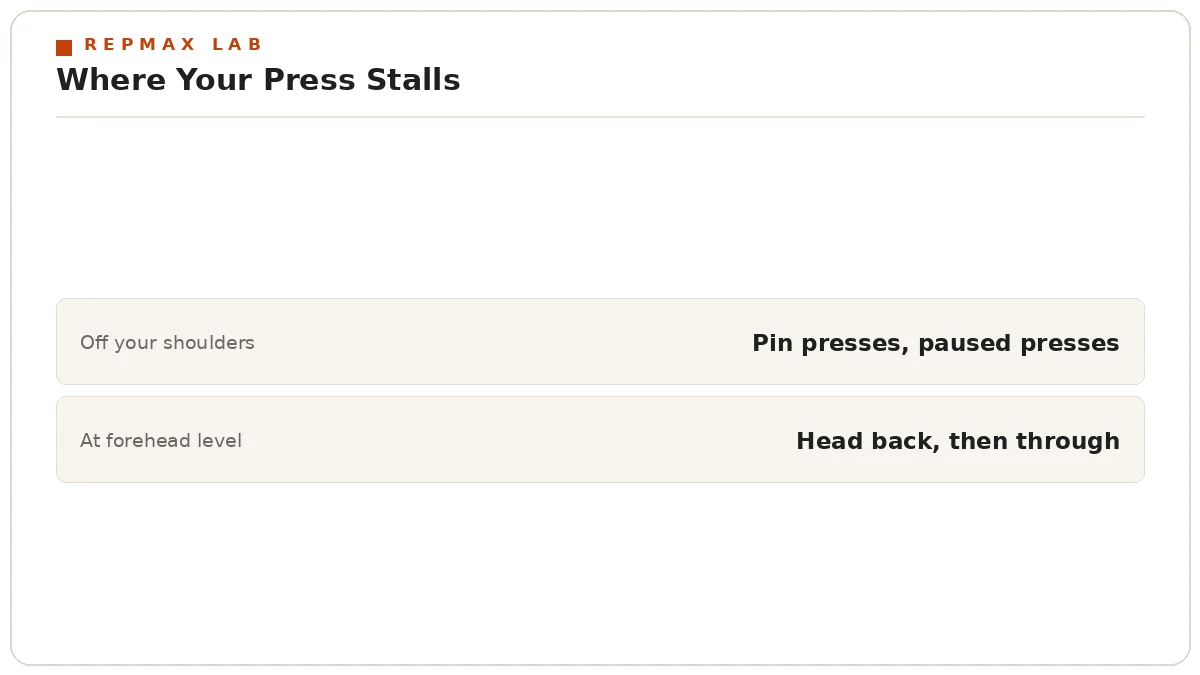
Step 1: Find where your press stalls
Knowing where you stall is the first step in how to increase overhead press strength. Film a heavy set from the side and watch where the bar slows down.
| Where it stalls | What it usually means | What to add |
|---|---|---|
| Off your shoulders | Weak front shoulders, or elbows too far behind the bar | Pin presses from chin height, paused presses at the bottom, elbows slightly in front of the bar |
| At forehead or eye level | Bar drifting forward around your face | Pull your head back, then push it “through” as the bar passes your forehead |
| Near lockout | Triceps are the limit | Close-grip bench, dips, overhead triceps extensions |
| You lean back a lot | Loose stomach and glutes, or tight lats and upper back | Brace before every rep, squeeze your glutes, try seated presses for a few weeks |
This mapping is standard coaching practice rather than something tested in a lab, so treat it as a starting point and judge it by your results over a few weeks.
Step 2: Fix your setup
When people ask how to increase overhead press numbers quickly, the honest answer is usually a better setup. It lets you use the strength you already have. Run through these checks before every work set:
- Grip. Hands just outside your shoulders, bar low in your palm and stacked over your wrists and elbows.
- Brace. Feet hip-width apart, glutes and stomach tight, ribs down. Hold your breath through each rep.
- Bar path. Pull your chin back so the bar can rise in a straight line past your face.
- Head through. Once the bar passes your forehead, push your head forward so the bar finishes over your midfoot.
- Lockout. Finish with locked elbows and a slight shrug toward the ceiling.
If you can’t get your arms overhead without arching your lower back, spend a few minutes on upper-back and lat mobility before you press.
Step 3: Use the right training dose
The research on how to increase overhead press strength is the same as for any lift. Each row below is backed by a meta-analysis:
| Training factor | What works | Evidence |
|---|---|---|
| Load | Most work above 60% of your 1RM, with regular sets at 80–90% | Heavier loads gave bigger 1RM gains than light loads (Schoenfeld et al., 2017, 21 studies) |
| Weekly sets | About 10 or more hard pressing sets a week | 10+ sets per exercise per week beat 5 or fewer for strength (Ralston et al., 2017) |
| Frequency | Press twice a week | More frequent training raised strength in multi-joint lifts, but not when weekly volume was equal (Grgic et al., 2018, 22 studies) |
| Protein | About 1.6 g per kg of bodyweight per day | Gains in muscle levelled off at about 1.6 g/kg/day (Morton et al., 2018) |
To pick loads without testing a max, the RPE calculator turns effort ratings into weights.
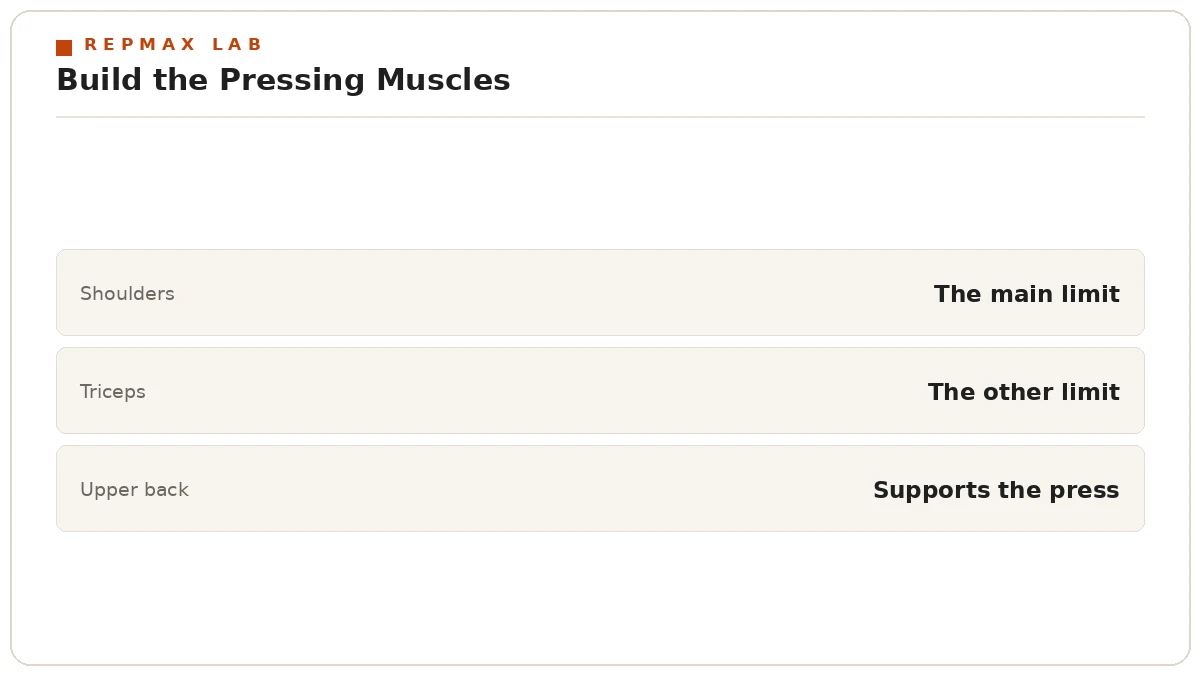
Step 4: Build the muscles that press
A big part of how to increase overhead press numbers is muscle: the press is limited by your shoulders and triceps, and supported by your upper back. Bigger, stronger muscles there raise your ceiling. Add 2–3 sets each of dips or close-grip bench for triceps, lateral raises for your shoulders, and rows or face pulls for your upper back. Your bench press helps too, so keep it moving with how to increase bench press.
Step 5: Add weight in small steps
Progressive overload, doing a bit more over time, is the core of how to increase overhead press strength over months. Because the press is a light lift, a 5 lb jump is a big percentage. Use the smallest plates your gym has:
| Your level | How to add weight | When to move on |
|---|---|---|
| Beginner (first months) | Add 2.5–5 lb (1–2.5 kg) each press session if you hit all reps | You miss reps two sessions in a row |
| Novice | Add 2.5–5 lb (1–2.5 kg) once a week, or add a rep to each set first | You stall for two or three weeks |
| Intermediate and beyond | Follow a planned block (like the 8-week plan below), then retest your max | After each block |
The plate calculator shows how to load each new weight, including small fractional plates.
Free 8-week plan to increase overhead press
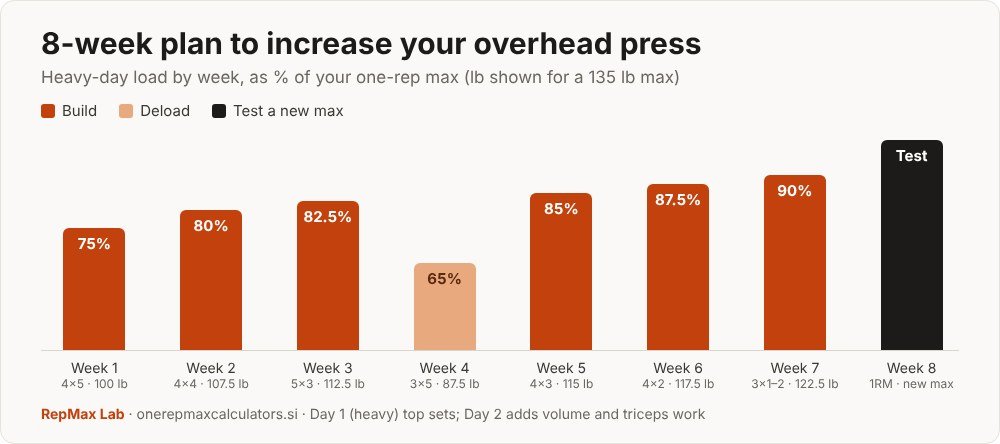
This is RepMax Lab’s plan: two press days a week, a lighter week in the middle and a test at the end. The weights below are for a 135 lb (61 kg) max. For your own numbers, multiply your max by each percentage, or use the percentage of one rep max chart.
| Week | Day 1: Heavy | Day 2: Volume and triceps |
|---|---|---|
| Week 1 | 4 × 5 at 75% (100 lb / 46 kg) | 4 × 8 at 65% (87.5 lb / 40 kg), then 3 × 8–10 dips or close-grip bench + 3 × 12 lateral raises |
| Week 2 | 4 × 4 at 80% (107.5 lb / 49 kg) | 4 × 8 at 67.5% (90 lb / 41 kg), then 3 × 8–10 dips or close-grip bench + 3 × 12 lateral raises |
| Week 3 | 5 × 3 at 82.5% (112.5 lb / 50 kg) | 5 × 7 at 70% (95 lb / 43 kg), then 3 × 8–10 dips or close-grip bench + 3 × 12 lateral raises |
| Week 4 (deload) | 3 × 5 at 65% (87.5 lb / 40 kg) | 2 × 8 at 60% (80 lb / 37 kg), then 2 × 10 dips or close-grip bench, RPE 6 |
| Week 5 | 4 × 3 at 85% (115 lb / 52 kg) | 4 × 6 at 72.5% (97.5 lb / 44 kg), then 3 × 8–10 dips or close-grip bench + 3 × 12 lateral raises |
| Week 6 | 4 × 2 at 87.5% (117.5 lb / 53 kg) | 4 × 6 at 75% (100 lb / 46 kg), then 3 × 8–10 dips or close-grip bench + 3 × 12 lateral raises |
| Week 7 | 3 × 1–2 at 90% (122.5 lb / 55 kg) | 3 × 5 at 75% (100 lb / 46 kg), then 3 × 8–10 dips or close-grip bench + 3 × 12 lateral raises |
| Week 8 | Warm up and work up to a new 1RM | Rest |
If you miss reps on a heavy day, repeat that weight next week instead of going up. Rows or pull-ups on both days keep your upper back strong.
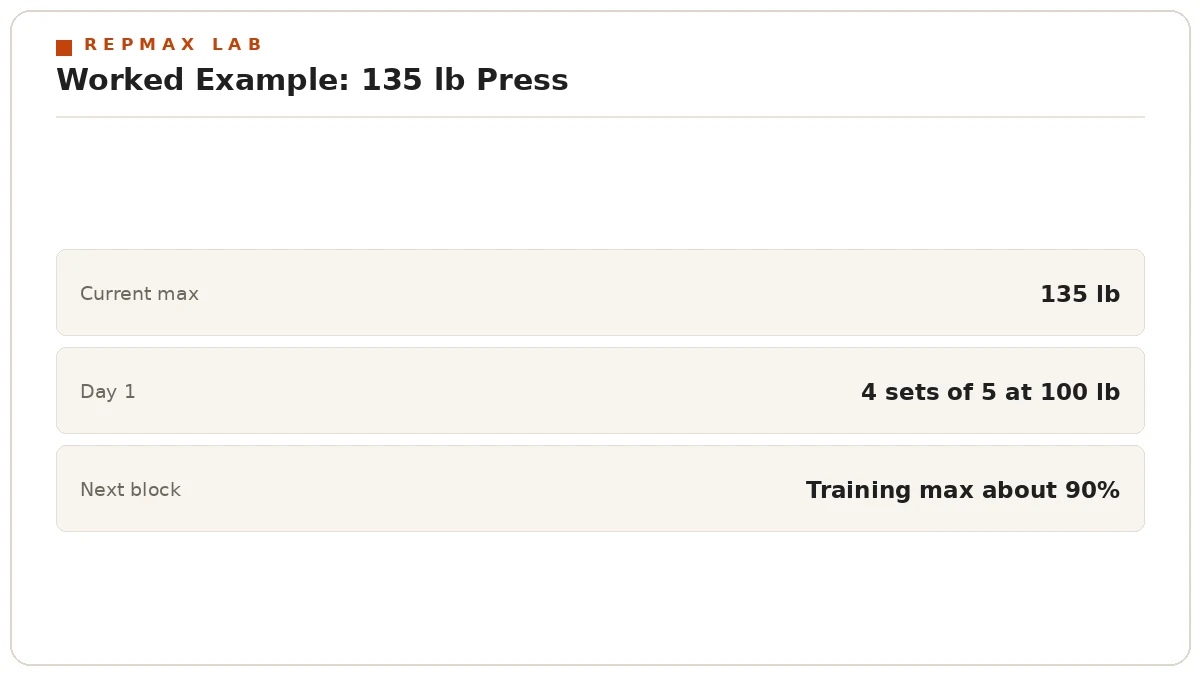
Worked example: 135 lb to a new max
Here is how to increase overhead press strength in practice. Jordan presses 135 lb (61 kg) for one rep and stalls near lockout. In week 1 he does 4 sets of 5 at 100 lb on Day 1. On Day 2 he does 4 sets of 8 at 87.5 lb, then dips. By week 7 his heavy singles are at 122.5 lb. In week 8 he warms up with the warm-up calculator and attempts a new max, following how to test your one-rep max.
If you would rather not max out, enter a hard set of 3–6 reps into the overhead press max calculator to estimate your new number. For the next block, set loads from a training max of about 90% of your new max.
Barbell or dumbbells?
Both work when you want to increase overhead press strength. Expect to lift less with dumbbells: in one study of 15 men, the standing dumbbell press 1RM was about 7% lower than the standing barbell press and about 10% lower than the seated dumbbell press (Saeterbakken & Fimland, 2013). Compare like with like when you track progress.
How do you know it is working?
The test of any plan for how to increase overhead press strength is simple: track your best set each week. If your estimated max goes up every 2–4 weeks, it is working. See where you stand on the strength standards calculator.
FAQ
Why is my overhead press so low?
The overhead press uses smaller muscles than the bench press, so it is normally the lightest of the main barbell lifts. On RepMax Lab’s standards, an Intermediate man presses about 0.55 × bodyweight, compared with about 0.75 × for the bench. If yours is far below that, the usual causes are pressing only once a week, too few hard sets, or a loose setup.
Is a 60 kg overhead press good?
It depends on your bodyweight. For an 80 kg man, 60 kg is 0.75 × bodyweight, near the top of the Intermediate band. For a 70 kg man it is about 0.86 ×, which is Advanced.
Is a 70 kg overhead press good?
Yes for most people. For an 80 kg man, 70 kg is about 0.88 × bodyweight, which is Advanced on RepMax Lab’s standards. For a 100 kg man it is 0.7 ×, which is Intermediate.
Why do I find overhead press so hard?
You are lifting with your shoulders and triceps through a long range, standing up, with nothing to lean on. Small fixes help most: brace your stomach and glutes, keep the bar over your wrists and elbows, and move your head back so the bar can travel in a straight line.
How do I increase my dumbbell shoulder press?
Use the same steps: press twice a week, mostly at 70–90% effort, and add weight in the smallest jumps your gym has. Expect lower numbers than with a barbell. In one study, men’s standing dumbbell press 1RM was about 7% lower than their standing barbell press.
How often should I overhead press?
Twice a week works for most lifters: one heavier day and one lighter day with more reps. Research shows the main benefit of training more often is fitting in more good sets, so make sure the second day adds real work.
Should I press seated or standing?
Both build strength. Standing trains your whole body to stay tight and carries over to most sports. Seated lets you lift a bit more and is easier to learn. Pick one as your main lift so you can track progress on it.
Related guides
Next steps after this guide on how to increase overhead press: read percentage of one rep max chart and how to test your one-rep max. For your other lifts, follow how to increase bench press, how to increase squat and how to increase deadlift.
Sources
- Saeterbakken, A. H., & Fimland, M. S. (2013). Effects of body position and loading modality on muscle activity and strength in shoulder presses. Journal of Strength and Conditioning Research, 27(7), 1824–1831. PubMed
- Schoenfeld, B. J., Grgic, J., Ogborn, D., & Krieger, J. W. (2017). Strength and hypertrophy adaptations between low- vs. high-load resistance training: a systematic review and meta-analysis. Journal of Strength and Conditioning Research, 31(12), 3508–3523. PubMed
- Ralston, G. W., Kilgore, L., Wyatt, F. B., & Baker, J. S. (2017). The effect of weekly set volume on strength gain: a meta-analysis. Sports Medicine, 47(12), 2585–2601. PMC5684266
- Grgic, J., Schoenfeld, B. J., Davies, T. B., et al. (2018). Effect of resistance training frequency on gains in muscular strength: a systematic review and meta-analysis. Sports Medicine, 48(5), 1207–1220. PubMed
- Morton, R. W., et al. (2018). A systematic review, meta-analysis and meta-regression of the effect of protein supplementation on resistance training-induced gains in muscle mass and strength in healthy adults. British Journal of Sports Medicine, 52(6), 376–384. PubMed
Weights are rounded to the nearest 2.5 lb and 1 kg. This guide is general training information, not medical advice. Last reviewed November 16, 2026.