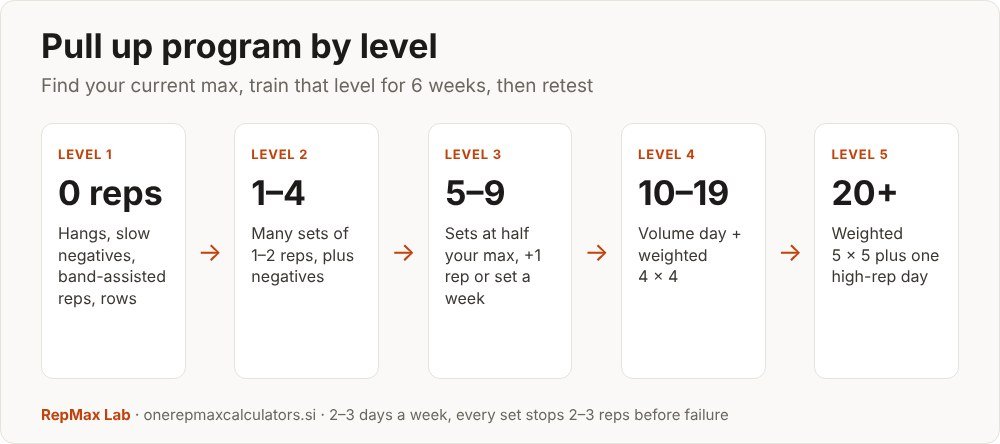
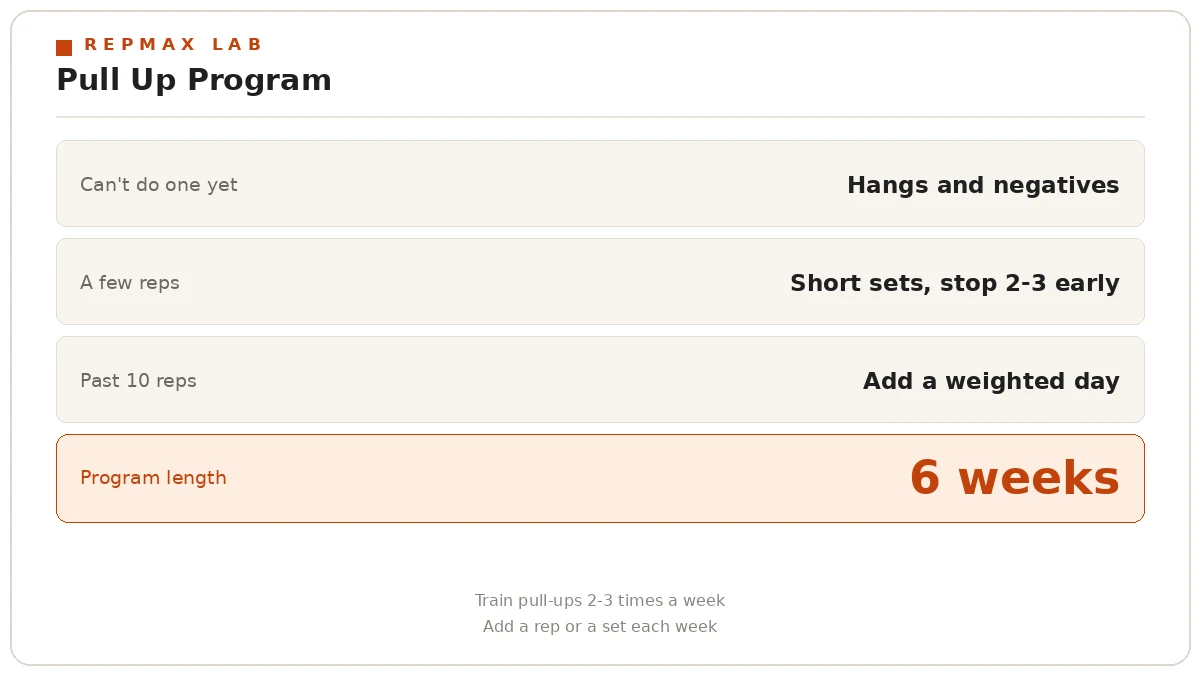
A good pull up program depends on how many pull-ups you can do today. If you can’t do one, train hangs, slow negatives and band-assisted reps two or three times a week. If you can do a few, do several short sets that stop 2–3 reps before failure and add a rep or a set each week. Past 10 reps, add a weighted day. Enter your max below to get a 6-week plan you can print.
This free pull up program covers every level, from your first rep to 20+, and explains how it compares with well-known plans like Armstrong. For the technique and the reasons behind it, read how to get better at pull ups.
Pull up program builder
Pick your pull up program by level
Test your max first: one set of strict pull-ups from a dead hang, chin over the bar, no swinging. Then find your row:
| Your max | Days a week | Main training | Goal for this block |
|---|---|---|---|
| 0 (first rep) | 2–3 | Dead hangs, scapular pull-ups, slow negatives, band-assisted reps, inverted rows | One strict pull-up |
| 1–4 | 3 | Many short sets of 1–2 reps, plus negatives | 5 strict reps |
| 5–9 | 2–3 | Sets at about half your max, adding a rep or a set each week | 10 strict reps |
| 10–19 | 2–3 | Bodyweight volume day plus a weighted strength day | 20 reps, or a strong weighted max |
| 20+ | 2 | Weighted 5 × 5 plus one high-rep day | Your own goal: weighted max or endurance |
Not sure where you stand? Compare your number with the pull-up standards.
Pull up program for beginners (0 reps)
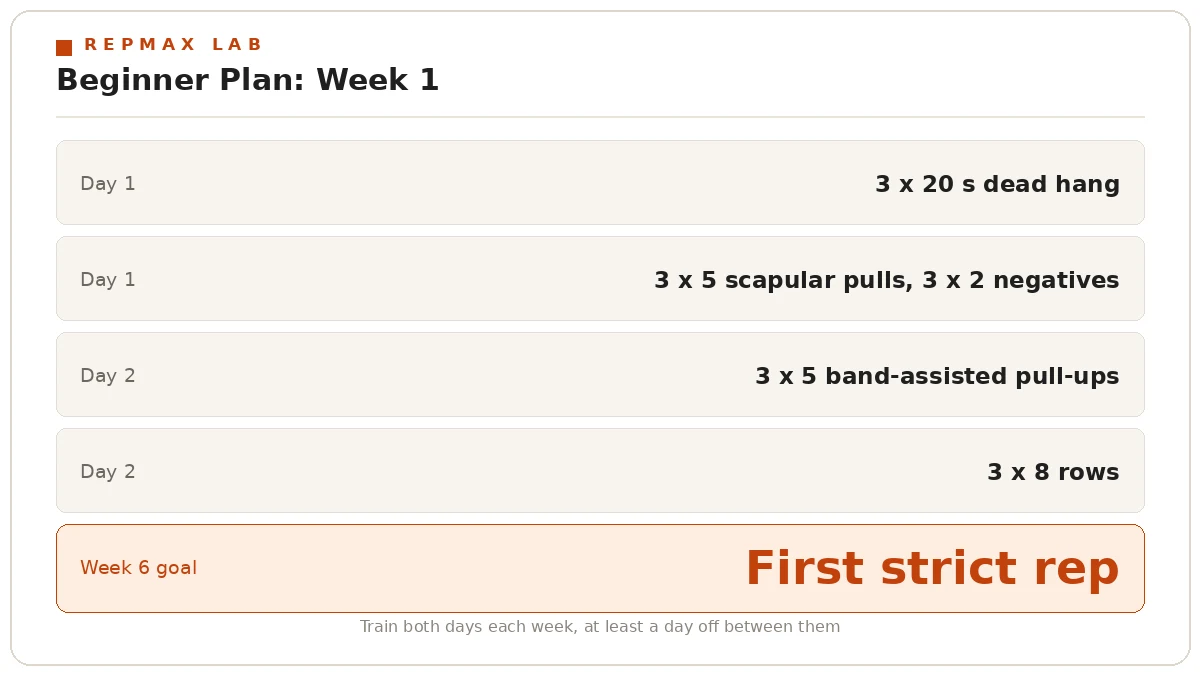
This 6-week plan builds the grip, back and arm strength for your first rep. Train both days each week, with at least a day off between them. Add a third session of Day 1 if you feel fresh.
| Week | Day 1 | Day 2 |
|---|---|---|
| 1 | 3 × 20 s dead hang, 3 × 5 scapular pulls, 3 × 2 negatives (3 s down), 3 × 8 rows | 3 × 5 band-assisted pull-ups (heavy band), 3 × 8 rows |
| 2 | 3 × 25 s hang, 3 × 6 scapular pulls, 3 × 3 negatives (3 s) | 3 × 5 band-assisted, 3 × 8 rows |
| 3 | 3 × 30 s hang, 3 × 3 negatives (4 s) | 4 × 5 band-assisted, 3 × 10 rows |
| 4 | 2 × 30 s hang, 2 × 3 negatives (4 s) (lighter week) | 3 × 4 band-assisted (lighter band) |
| 5 | 3 × 30 s hang, 4 × 3 negatives (5 s) | 4 × 5 band-assisted (lighter band), 3 × 10 rows |
| 6 | Try one strict pull-up after a warm-up. Then 3 × 3 negatives (5 s) | 3 × 5 band-assisted (lightest band you can manage) |
If you can’t get a strict rep in week 6, repeat weeks 4–6 with a lighter band and longer negatives. Needing more than one round is fine. Keep going.
Pull up program for 5–9 reps
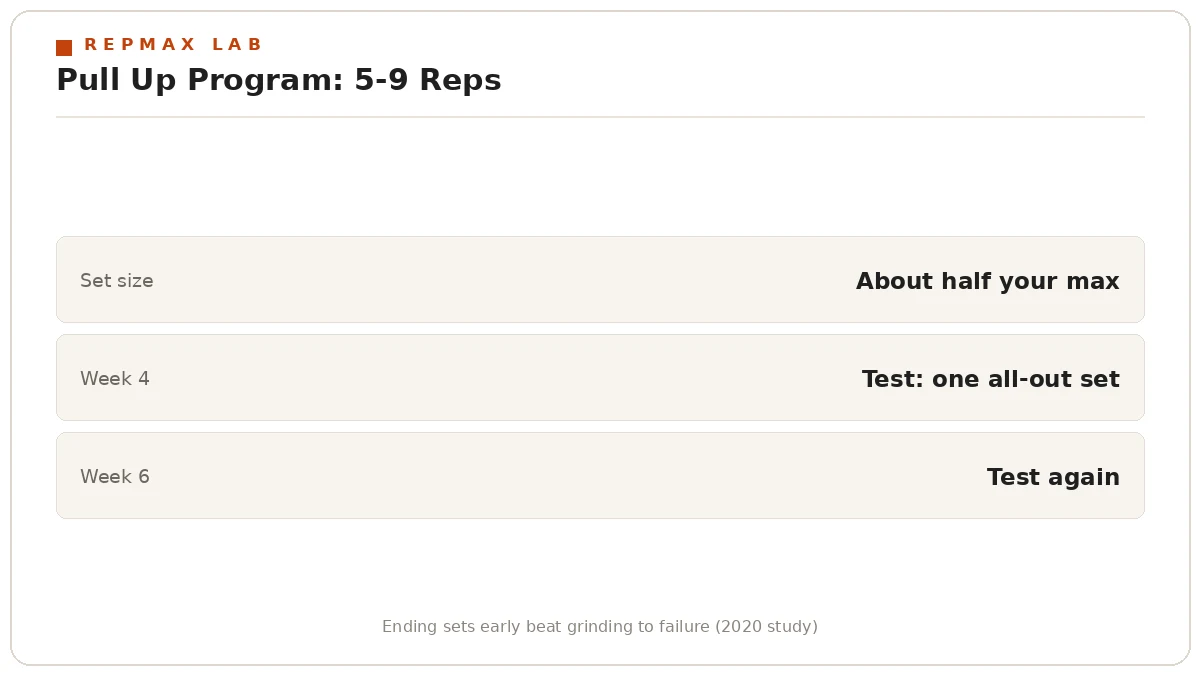
This is the core of the plan: short sets, lots of practice, no grinding. The sets below are for a max of 6. For a different max, keep each set at about half your max reps, or use the builder above.
| Week | Day 1 | Day 2 (2–3 days later) |
|---|---|---|
| 1 | 5 × 3 | 6 × 2 + 3 negatives |
| 2 | 6 × 3 | 5 × 3 + 3 negatives |
| 3 | 5 × 4 | 6 × 3 |
| 4 | Test: one all-out set | 3 × 3 (lighter) |
| 5 | 6 × 4 | 5 × 4 + 3 negatives |
| 6 | Test: one all-out set | Rest |
Why stop short of failure? In a controlled 8-week study, trained men who ended each pull-up set early made bigger strength gains than men who pushed much closer to failure (Sánchez-Moreno et al., 2020).
Pull up program for 10–20 reps
Once you can do 10, extra weight builds strength faster than more bodyweight reps. Pair a volume day with a weighted day. Use a dip belt, a weight vest or a dumbbell held between your feet.
| Week | Day 1: Volume | Day 2: Weighted |
|---|---|---|
| 1 | 6 × 6 bodyweight | 4 × 4 with +5 lb (2.5 kg) |
| 2 | 7 × 6 | 4 × 4 with +10 lb (5 kg) |
| 3 | 6 × 7 | 5 × 4 with +10 lb |
| 4 | Test: one all-out set | 3 × 3 with +5 lb (lighter) |
| 5 | 7 × 7 | 4 × 4 with +15 lb (7.5 kg) |
| 6 | Test: one all-out set | Rest |
Track your weighted strength with the one rep max calculator: enter your bodyweight plus the added weight and your reps.
Popular pull up programs compared
You’ll find these names in most searches for a pull up program. Here is how they differ, so you can pick one that fits your week:
| Program | How it works | Best for |
|---|---|---|
| RepMax Lab plan (this page) | 2–3 days a week, short sets that stop 2–3 reps before failure, retest every 3 weeks | Busy people who also lift or run |
| Armstrong pull-up program | 5 days a week, created by a US Marine officer. Starts with five max-effort sets on Monday and a pyramid day on Tuesday | Military test prep, if you can train every weekday |
| Starting From Zero (US Marine Corps) | A class-based program built around partner-assisted, negative, jumping and partial-range pull-ups | Getting a first rep |
| Fighter pullup program (StrongFirst) | Frequent short, easy sets rather than max-effort days | People who can already do a few reps and train often |
| Greasing the groove | Easy sets of about half your max, spread through the day | Home training with a doorway bar |
All of them share the same idea: practice often and do more over time. The main difference is how hard each set is. The Armstrong program uses sets to failure; most others, including ours, stop well before it.
Rules that make any pull up program work
- Only count clean reps. Dead hang at the bottom, chin over the bar, no kicking.
- Rest 2–3 minutes between sets on training days. Short rest turns strength work into fatigue.
- Retest every 3 weeks and update your sets. If your max went up, your sets go up too.
- Add rows and hangs. Inverted rows and dead hangs build the back and grip that pull-ups need.
- Mind your bodyweight. Pull-ups lift your whole body, so losing fat makes every rep easier.
- Back off if your elbows ache. Take a lighter week, and switch some sessions to chin-ups or neutral grip.
FAQ
What is a good pull-up routine?
A good routine matches your current max. If you can’t do one yet, use hangs, negatives and band-assisted reps two or three times a week. If you can do a few, do several short sets that stop 2–3 reps before failure and add a rep or a set each week. Once you reach 10+, add a weighted day.
What is a good program to increase my pull-ups?
Pick the plan for your level on this page, or enter your max into the program builder. Train two or three days a week, keep sets well short of failure, and retest every 3 weeks.
What will 20 pull-ups a day do?
Spread across the day in easy sets, 20 pull-ups a day is good practice and can raise your reps, especially if your max is above 8. Doing them as one hard set to failure every day is more likely to leave you tired and sore than stronger.
Is there a free pull up program PDF?
Use the print button on this page. It prints the program builder results and the plans for each level on a clean sheet you can take to the gym.
Is the Armstrong pull-up program good?
It is a well-known 5-day plan created by a US Marine officer, and many people have used it to prepare for military fitness tests. It includes sets to failure, such as five max-effort sets on Monday. If you prefer fewer sessions, the plans here use 2–3 days and stop sets before failure.
Is there a pull-up program for women?
The programs on this page work the same for women and men. Start at the level that matches your current max. Most beginners, women and men alike, start with the first-rep plan.
How long does a pull-up program take to work?
Most people notice that their sets feel easier within 2–3 weeks. Test your max at the end of each 3-week block. A controlled study saw trained men improve their pull-up strength and max reps over 8 weeks of twice-weekly training.
Related guides
For technique and the science behind this pull up program, read how to get better at pull ups. Check your level with the pull-up standards, and build the rest of your strength with how to increase bench press and how to increase deadlift.
Sources
- Sánchez-Moreno, M., Cornejo-Daza, P. J., González-Badillo, J. J., & Pareja-Blanco, F. (2020). Effects of velocity loss during body mass prone-grip pull-up training on strength and endurance performance. Journal of Strength and Conditioning Research, 34(4), 911–917. PubMed
- U.S. Marine Corps, Zero to Twenty-plus: Marine develops program to improve pull-ups, 2016.
- InsideHook, Charles Armstrong Pull-Up Program, 2023 (Armstrong program structure).
- StrongFirst, The Fighter Pullup Program.
This program is general training information, not medical advice. Last reviewed November 16, 2026.