What is a one rep max?
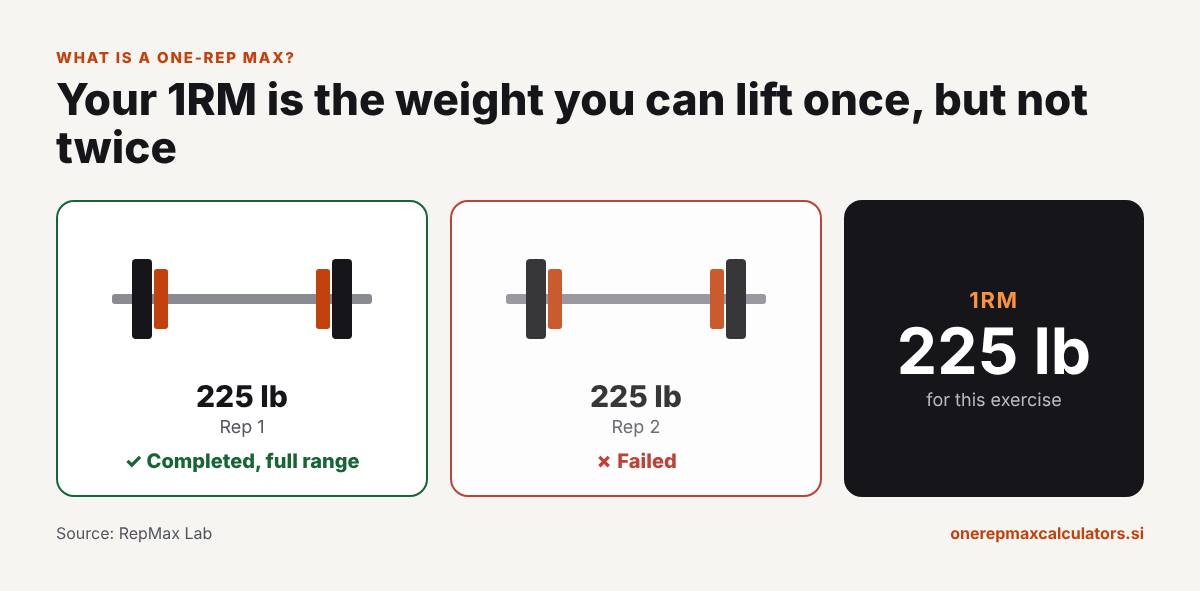
A one-rep max (1RM) is the heaviest weight you can lift for one complete repetition with good form. If you can lift a weight once but not twice, that weight is your 1RM for that exercise. You can test it with a single heavy lift, or estimate it safely from a set of several reps with our one rep max calculator.
This guide explains what a 1RM is, how to work yours out, when testing is worth it, and how to use the number to set your training weights.
What a one-rep max means
“RM” stands for repetition maximum: the most weight you can lift for a set number of reps. Your 1RM is the most you can lift once; your 5RM is the most you can lift for five reps. Three rules make a rep count:
- Full range of motion. Bar to chest and lockout on the bench press; hip crease below the knee on a competition squat; hips and knees locked at the top of a deadlift.
- No help. If a spotter touched the bar, the rep doesn’t count.
- One exercise at a time. A 1RM belongs to one lift. Your squat max says nothing exact about your deadlift.
1RM vs rep max vs training max vs estimated 1RM
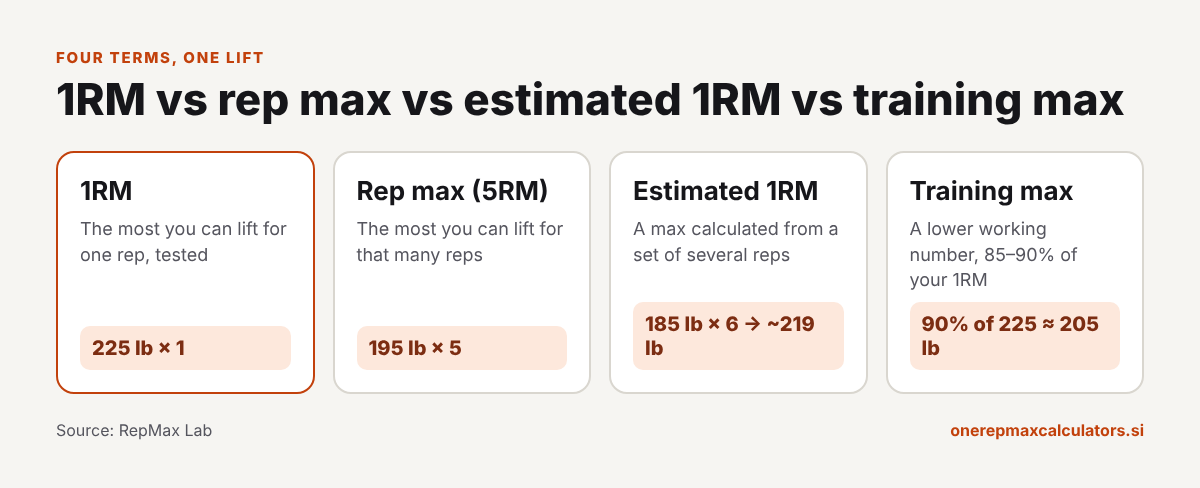
Programs and apps use these four terms differently. Here’s what each one means:
| Term | What it means | Example |
|---|---|---|
| 1RM | The most you can lift for one rep, tested | Bench 225 lb for 1 rep |
| Rep max (e.g. 5RM) | The most you can lift for that many reps | Bench 195 lb for 5 reps |
| Estimated 1RM (e1RM) | A 1RM calculated from a set of several reps | 185 lb × 6 reps → about 219 lb |
| Training max (TM) | A lower working number, usually 85–90% of your 1RM | 90% of 225 lb ≈ 205 lb |
Programs such as 5/3/1 base their weights on a training max so the sets stay repeatable on a bad day. Our training max calculator works it out for you.
How to calculate your 1RM from a set
You don’t need to lift your max to know it. The most common formula, Epley, multiplies the weight by 1 plus your reps divided by 30:
1RM = weight × (1 + reps ÷ 30)
Example: you bench 185 lb for 6 reps and couldn’t do a seventh. 185 × (1 + 6 ÷ 30) = 185 × 1.2 = 222 lb. Other formulas, such as Brzycki (1993), give slightly different answers, so our calculator averages seven of them: about 219 lb, with a range of 213–225 lb. Try this example in the calculator.
For a reliable estimate:
- Use 10 reps or fewer. In a study of 70 men and women, 5-rep sets predicted 1RM best and accuracy fell as reps rose; the authors advised staying at or under 10 (Reynolds et al., 2006).
- Go close to failure. The math assumes you couldn’t have done another rep. If you had reps left, add them as reps in reserve in the calculator.
- Count clean reps only. Half reps and bounces at the end of a set inflate the number.
More on accuracy: how accurate 1RM calculators are.
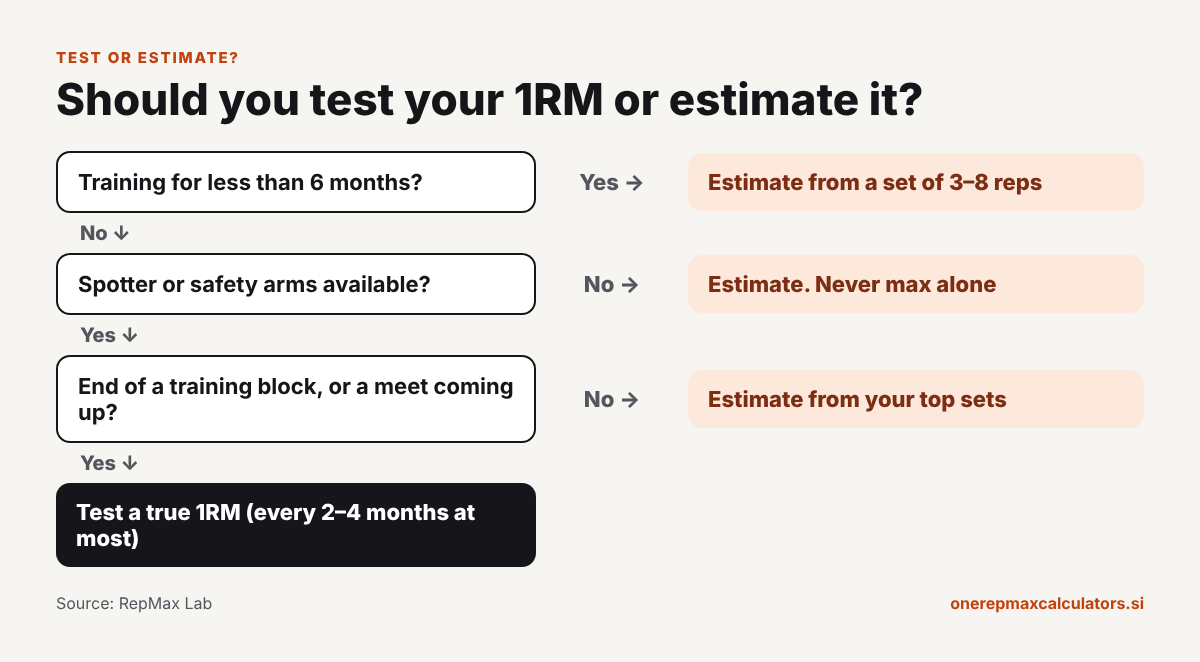
Should you test your 1RM or estimate it?
| Your situation | What to do |
|---|---|
| Training under 6 months | Estimate from a hard set of 3–8 reps. Your max changes too fast to be worth testing. |
| Training 6+ months, no spotter or safety arms | Estimate. Never take a max single alone on the bench press or squat. |
| Intermediate, end of a training block | Test once every 2–4 months if you want an exact number; estimate in between. |
| Competing in powerlifting | Test before a meet to choose your attempts. |
| Returning after 3+ weeks off | Estimate first, and test only once you’re back near your old numbers. |
1RM tests are reliable from one session to the next when done properly (Grgic et al., 2020), but they’re tiring and carry more risk than a normal set. For most training decisions, an estimate is enough.
How to test a 1RM safely
The National Strength and Conditioning Association (NSCA) protocol, as summarised by HPRC, works up in shrinking jumps so you reach your max within a few attempts:
| Step | Load | Reps | Rest after |
|---|---|---|---|
| 1. Warm up | Light | 5–10 | 1 min |
| 2. Second warm-up | +10–20 lb (upper body) / +30–40 lb (lower body) | 3–5 | 2 min |
| 3. Near-max set | Same jumps again | 2–3 | 2–4 min |
| 4. Attempt | Same jumps again | 1 | 2–4 min |
| 5. Adjust | Success: add weight. Miss: take off 5–10 lb (upper) / 15–20 lb (lower) | 1 | 2–4 min |
Aim to find your max within 3–5 attempts after warming up. Our warm-up calculator builds the sets and plates for you, and the full walkthrough is in how to test your one-rep max.
Safety checklist:
- Use a spotter who knows when to help, or set safety arms just below your lowest bar position.
- Test when you’re fresh, not after a hard week.
- Test one or two lifts per session, not all of them.
- Stop the session if your technique breaks down. A grinding, ugly rep isn’t worth an injury.
How to use your 1RM in training
Most strength programs prescribe sets as a percentage of your 1RM. The NSCA training zones are:
| Goal | % of 1RM | Reps per set | With a 225 lb 1RM |
|---|---|---|---|
| Strength | 85% or more | 6 or fewer | 190–225 lb |
| Muscle growth (hypertrophy) | 67–85% | 6–12 | 150–190 lb |
| Muscular endurance | Under 67% | 12 or more | Under 150 lb |
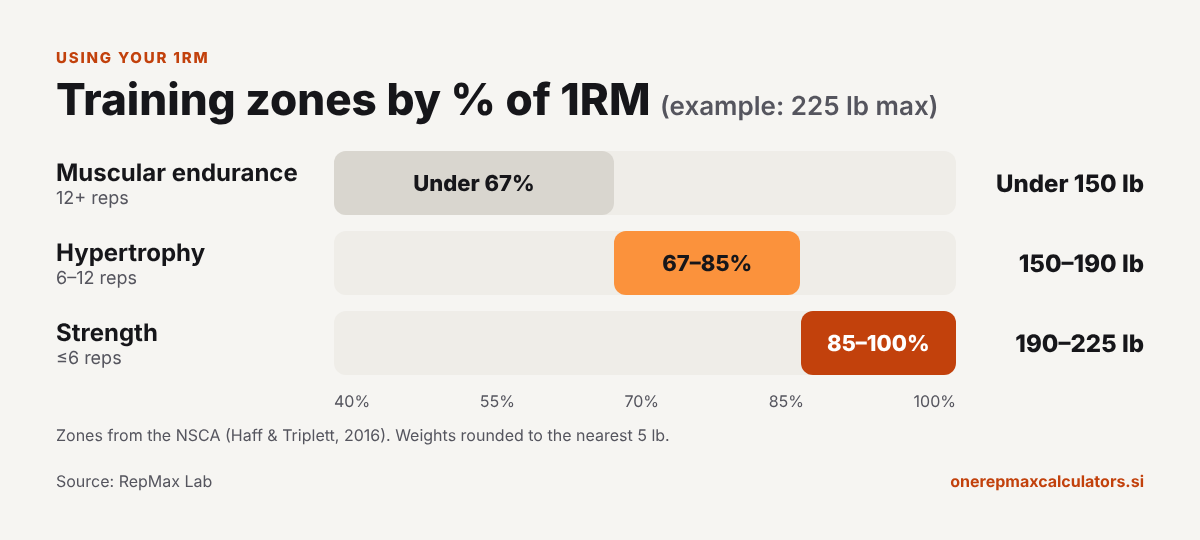
For example, a program calling for 5 × 5 at 80% with a 225 lb max means sets of 5 at 180 lb. For every percentage from 50% to 100%, use the percentage of 1RM chart, and for reps at each percentage, the rep max chart.
Common mistakes
- Counting partial reps. They inflate both tested and estimated maxes.
- Estimating from sets of 15+ reps. Formulas can disagree by 20% or more at high reps.
- Using one lift’s max for another. Each exercise needs its own number.
- Ignoring the style of the lift. A touch-and-go bench max is usually higher than a paused one, and a high squat inflates your number. Estimate with the same style you plan to train or compete with.
- Testing too often. Maximal singles every week add fatigue without making you stronger. See how often to test your 1RM.
Frequently asked questions
What is 75% of your 1RM?
75% of your 1RM is a weight most people can lift for about 10 reps. If your max is 200 lb, 75% is 150 lb.
What is 70% of your 1RM?
70% of your 1RM is roughly an 11–12 rep weight, often used for muscle-building sets. With a 200 lb max, 70% is 140 lb.
How do I convert a 3-rep max to a 1-rep max?
Divide your 3-rep max by about 0.92. For example, 200 lb for 3 reps works out to roughly 217–218 lb. The calculator does this for you.
What is a good one-rep max?
It depends on your bodyweight, sex, age and training age, so compare against your own past numbers first. As rough gym benchmarks, many male lifters see a bodyweight bench press, a 1.5× bodyweight squat and a 2× bodyweight deadlift as solid intermediate milestones; women’s benchmarks are typically lower relative to bodyweight.
How accurate is an estimated 1RM?
From a set of 10 reps or fewer taken close to failure, an estimate is usually close enough to set training weights. Accuracy drops as reps rise.
How often should I test my 1RM?
Test a true max every 2–4 months at most, and estimate it every 3–6 weeks from a normal top set in between.
Should beginners test their 1RM?
Usually not in the first few months. Estimate from a hard set of 3–8 reps instead, and test a true single once your technique is consistent and you have a spotter or safety arms.
Sources
- Haff, G. G., & Triplett, N. T. (Eds.). (2016). Essentials of Strength Training and Conditioning (4th ed.). NSCA / Human Kinetics.
- Human Performance Resources by CHAMP (HPRC). (2022). What is a one-rep max?
- Reynolds, J. M., Gordon, T. J., & Robergs, R. A. (2006). Prediction of one repetition maximum strength from multiple repetition maximum testing and anthropometry. Journal of Strength and Conditioning Research, 20(3), 584–592. PDF
- Grgic, J., Lazinica, B., Schoenfeld, B. J., & Pedisic, Z. (2020). Test–retest reliability of the one-repetition maximum (1RM) strength assessment: a systematic review. Sports Medicine – Open, 6, 31. PubMed
- Brzycki, M. (1993). Strength testing: predicting a one-rep max from reps-to-fatigue. Journal of Physical Education, Recreation & Dance, 64(1), 88–90. Publication page