How to get better at pull ups, in short: train them two or three times a week, do several short sets that stop 2–3 reps before failure, add a rep or a set each week, and build your grip and upper back with hangs and rows. If you can’t do one yet, work up a simple ladder: dead hangs, slow negatives, then band-assisted reps. In one controlled study, ending sets early led to bigger strength gains than grinding to failure.
This guide on how to get better at pull ups covers your first rep, how to increase pull ups once you have a few, and a free 8-week plan you can follow at home or in the gym. To see where you stand now, check the pull-up standards.
Step 1: Know your starting point
Do one set of strict pull-ups with a dead hang at the bottom and your chin over the bar at the top. No kipping or swinging. Count only clean reps. That number decides where you start:
| Where you are | What to do | Move on when |
|---|---|---|
| 0 pull-ups | Dead hangs (build to 30 seconds), scapular pull-ups, inverted rows | You can hang for 30 seconds and do 3 × 8 inverted rows |
| Still 0 | Slow negatives: jump to the top, lower for 3–5 seconds, 3 × 3 | Your negatives last 5 seconds and feel controlled |
| Still 0 | Band-assisted pull-ups, 3 × 5, moving to a lighter band over time | You can do 5 reps with the lightest band |
| 1–3 pull-ups | Several sets of 1–2 reps through the week, plus negatives | You can do 4–5 in one set |
| 4+ pull-ups | The 8-week plan below | After each 8-week block, retest |
Step 2: Fix your form
Clean form often adds a rep or two straight away. Check these before every set:
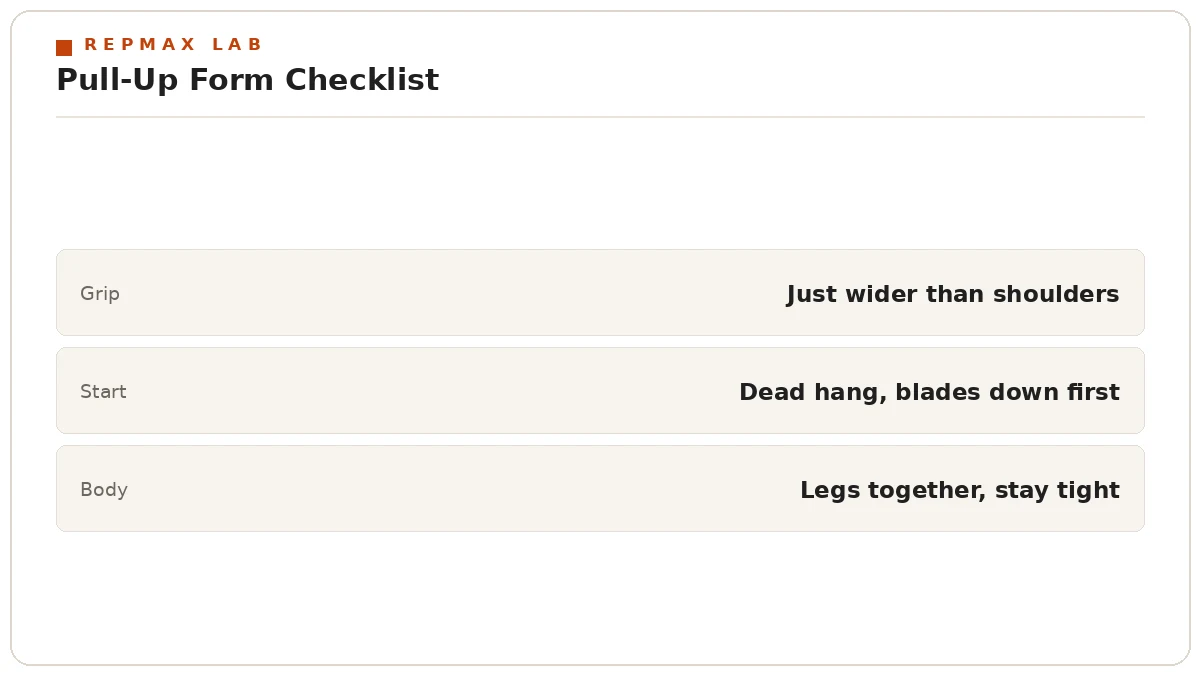
- Grip. Hands slightly wider than your shoulders, palms facing away. Wrap your thumbs around the bar.
- Start from a dead hang. Arms straight, then pull your shoulder blades down before you bend your elbows.
- Stay tight. Legs together, glutes and stomach squeezed, so your body doesn’t swing.
- Pull your chest toward the bar. Drive your elbows down to your sides and aim to get your chin over the bar.
- Lower with control. Take about 2 seconds on the way down. The lowering part builds strength too.
Step 3: Stop sets before failure
The biggest mistake when learning how to increase pull ups is maxing out every session. A study of 29 trained men compared two 8-week pull-up programs. One group ended each set once their rep speed dropped by 25%. The other kept going until it dropped by 50%, much closer to failure. The first group made bigger strength gains and improved on every measure, while the second group showed no significant improvement (Sánchez-Moreno et al., 2020).
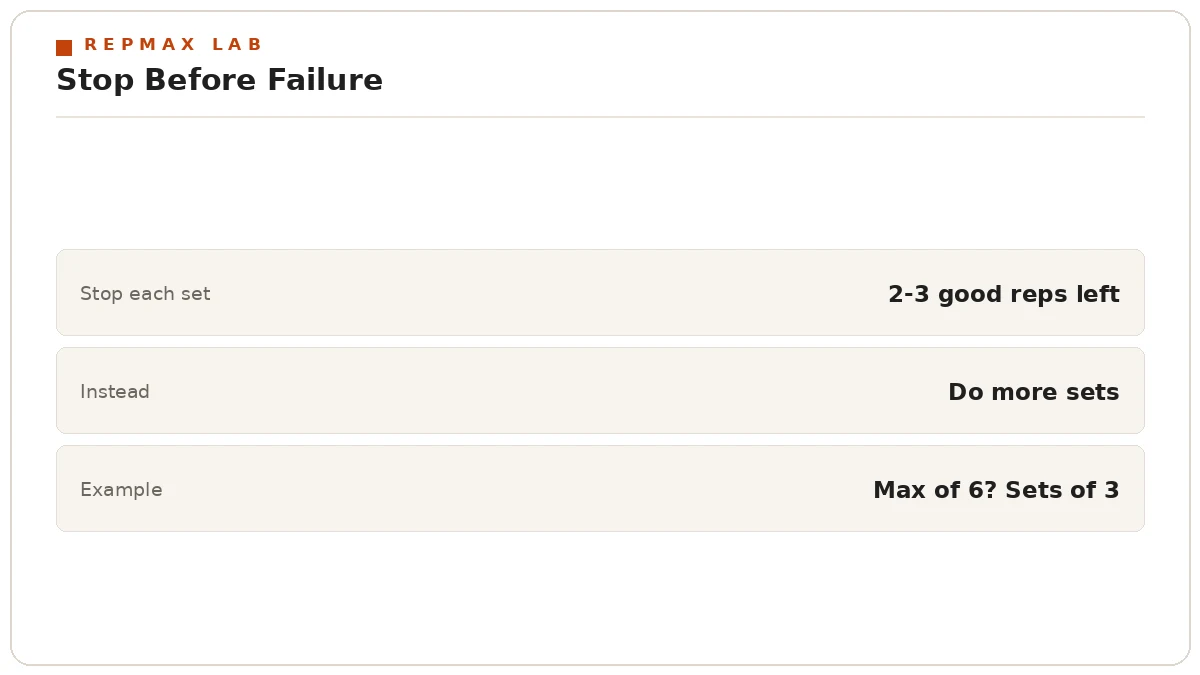
In practice, stop each set when you have 2–3 good reps left. Do more sets instead. If you can do 6, sets of 3 are a good start.
Step 4: Train often and build your support muscles
Pull-ups are a skill as well as a strength test, so practice matters. Two or three sessions a week work well. Research on strength training found that more frequent training helps mainly by letting you fit in more good sets each week (Grgic et al., 2018). Weekly volume matters too: 10 or more hard sets per exercise per week gave bigger strength gains than 5 or fewer (Ralston et al., 2017).
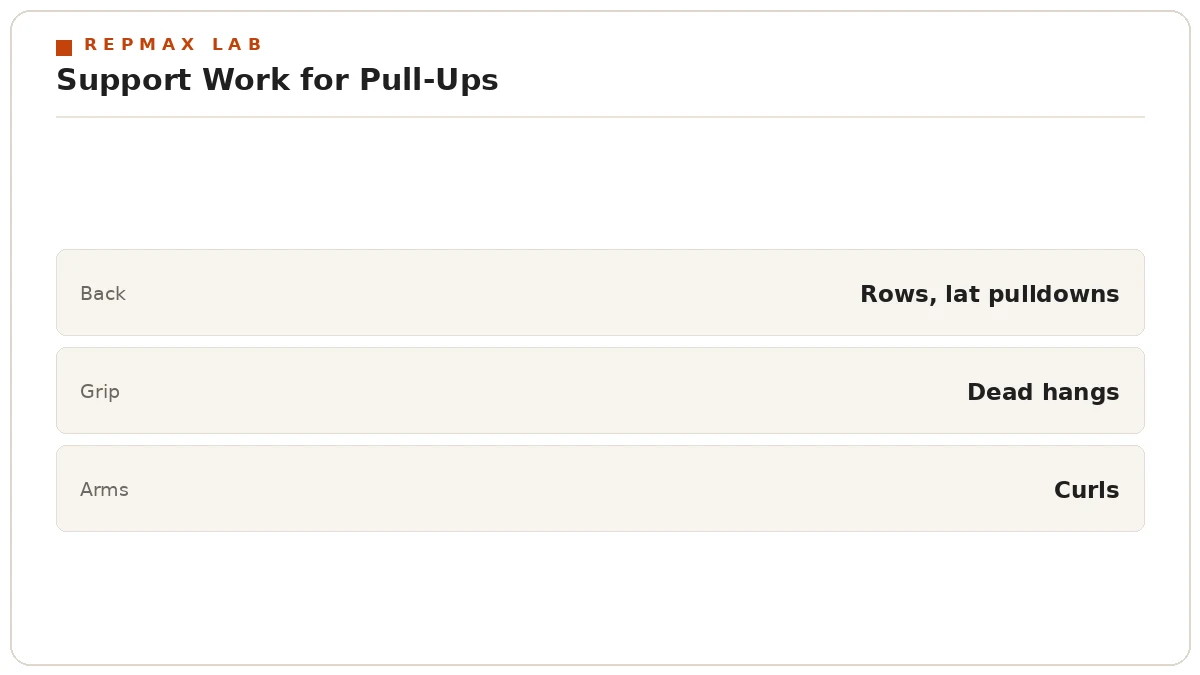
Add support work two or three times a week: inverted rows or lat pulldowns for your back, dead hangs for your grip, and curls for your biceps.
Step 5: Add reps, then add weight
Progressive overload, doing a bit more over time, is the core of how to get better at pull ups. Add one rep to each set, or one extra set, every week. Once you can do 10–12 clean reps, start adding weight: a 2.5–5 lb (1–2.5 kg) plate on a dip belt or in a backpack. Track your weighted max with the one rep max calculator.
Your bodyweight counts as well. Pull-ups lift your whole body, so losing body fat makes every rep easier, and gaining it makes them harder.
How to do more pull ups in your next set
Training takes weeks, but a few things help you do more pull ups today. None of them replace the plan, but they make sure your test set shows your real strength:
- Warm up first. Do 2–3 easy reps, rest 2–3 minutes, then go. Cold muscles give up early.
- Rest fully before a test. A set right after other back work will always be lower.
- Use chalk or dry hands. Many sets end because the grip slips, not because the back is done.
- Keep the reps clean but steady. Don’t rush, and don’t pause at the bottom long enough to lose tension.
- Breathe at the bottom. Take a quick breath in the dead hang, then pull.
For a full program by level, including a builder that sets your reps from your current max, see the pull up program.
Free 8-week plan to get better at pull ups
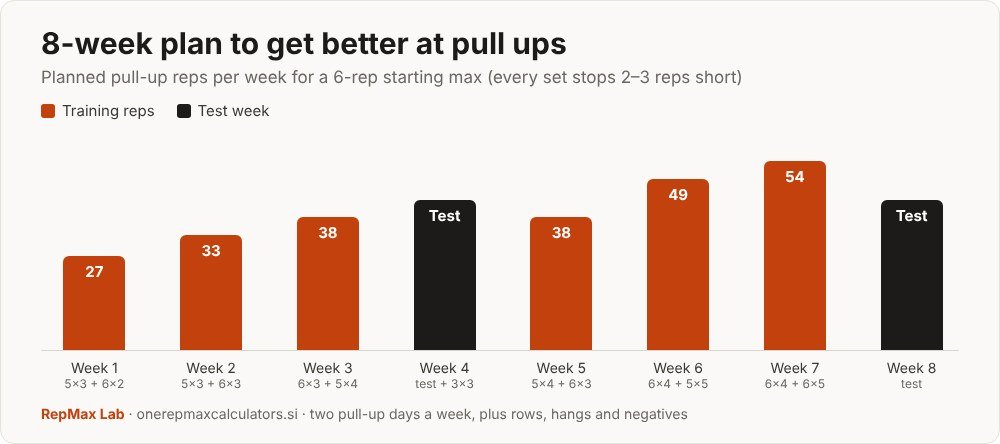
This is RepMax Lab’s plan for someone who can do about 6 strict pull-ups. Rest 2–3 minutes between sets and stop each set with 2–3 reps left. If you can do more or fewer, keep each set at about half your max reps.
| Week | Day 1 | Day 2 (2–3 days later) | Support work (both days) |
|---|---|---|---|
| Week 1 | 5 × 3 | 6 × 2, plus 3 slow negatives (5 seconds down) | 3 × 10 inverted rows or lat pulldowns |
| Week 2 | 5 × 3 | 6 × 3 | 3 × 10 rows, 3 × 30-second dead hangs |
| Week 3 | 6 × 3 | 5 × 4 | 3 × 10 rows, 3 × 30-second dead hangs |
| Week 4 (lighter) | Test: one all-out set | 3 × 3 | 2 × 10 rows |
| Week 5 | 5 × 4 | 6 × 3, plus 3 slow negatives | 3 × 10 rows, 3 × 12 curls |
| Week 6 | 6 × 4 | 5 × 5 | 3 × 10 rows, 3 × 30-second dead hangs |
| Week 7 | 6 × 4 | 6 × 5 | 3 × 10 rows, 3 × 12 curls |
| Week 8 | Test: one all-out set | Rest | Rest |
On test days, warm up with a few easy reps, rest 3 minutes, then do one set of as many clean reps as you can. If a set feels much harder than planned, drop a rep from each set that week.
Worked example: 6 to 10 pull-ups
Here is how to increase pull ups in practice. Sam can do 6 strict pull-ups. In week 1 he does 5 sets of 3 on Day 1 and 6 sets of 2 plus negatives on Day 2, about 27 pull-ups a week. By week 7 he does 6 sets of 4 and 6 sets of 5, 54 pull-ups a week, without ever going to failure. In week 8 he tests again.
How much should he expect? That varies a lot. If he hits 10 reps, the next step is adding a small weight, as in Step 5.
How do you know it is working?
The test of any plan for how to get better at pull ups is simple: your test set goes up every 4 weeks, and your normal sets feel easier. Compare your result with the pull-up standards, which include averages by level and the Marine Corps test scores.
FAQ
How can I build strength to do pull-ups?
Start with dead hangs, inverted rows and slow negatives, then move to band-assisted pull-ups. Train them two or three times a week. Once you can lower yourself slowly for 5 seconds and do 5 reps with a light band, try your first full rep.
Why am I so weak at pull-ups?
Pull-ups lift your whole bodyweight, so they test strength relative to your size. The usual reasons are not training them often enough, always going to failure, or a weak grip and upper back. Carrying extra bodyweight also makes every rep harder.
How quickly can you improve pull-ups?
Most people see progress within a few weeks of training two or three times a week. In one study, trained men who could already do about 16 pull-ups improved their strength and max reps over 8 weeks of twice-weekly training, as long as they stopped each set well before failure.
How do I get better at pull-ups at home?
Hang a doorframe pull-up bar, and use a sturdy table or a broomstick between two chairs for inverted rows. Follow the same plan: short sets, two or three times a week, plus slow negatives.
How do women get better at pull-ups?
The steps are the same. Women often start with fewer reps, so the ladder (hangs, negatives, bands) is the usual way in.
Should I go to failure on pull-ups?
Usually not. In a controlled study, men who ended each set early (losing 25% of their rep speed) gained more strength than those who pushed much closer to failure. Stop each set when you have 2–3 reps left.
How many pull-ups should I be able to do?
It depends on your sex, age and goal. See the pull-up standards page for averages by level and the Marine Corps fitness test scores.
How long does it take to increase pull-ups?
Most people notice their sets feel easier within 2–3 weeks of training two or three times a week. Test every 4 weeks. Bigger jumps, like going from 5 to 10, usually take a couple of training blocks.
Is there a trick to doing more pull ups?
No single trick. What works is practicing often, stopping sets before failure, and adding a rep or a set each week. On test day, warm up, rest fully and use chalk.
Related guides
Next steps after this guide on how to get better at pull ups: check the pull-up standards, then build your other lifts with how to increase bench press, how to increase overhead press and how to increase deadlift.
Sources
- Sánchez-Moreno, M., Cornejo-Daza, P. J., González-Badillo, J. J., & Pareja-Blanco, F. (2020). Effects of velocity loss during body mass prone-grip pull-up training on strength and endurance performance. Journal of Strength and Conditioning Research, 34(4), 911–917. PubMed
- Grgic, J., Schoenfeld, B. J., Davies, T. B., et al. (2018). Effect of resistance training frequency on gains in muscular strength: a systematic review and meta-analysis. Sports Medicine, 48(5), 1207–1220. PubMed
- Ralston, G. W., Kilgore, L., Wyatt, F. B., & Baker, J. S. (2017). The effect of weekly set volume on strength gain: a meta-analysis. Sports Medicine, 47(12), 2585–2601. PMC5684266
This guide is general training information, not medical advice. Last reviewed November 16, 2026.